10 Bible Verses That Prove Jesus Is King (You’ve Probably Never Heard #5)
The phrase “Jesus is King” has been showing up everywhere lately (even the title of a studio album by American rapper Kanye West) — but for many Christian people, it’s not a trend at all. It’s at the heart of their faith.
Scripture doesn’t just call Jesus a good teacher or a wise man; from the Old Testament all the way through the New, it declares Him King Jesus, the promised ruler of Gods plan from the very beginning.
This truth carries layers most readers never stop to notice. Some of these verses hold double meanings — quiet Old Testament prophecies that only make sense once you see how perfectly they were fulfilled centuries later.
Others are bold, direct declarations spoken by Jesus Himself, by His earliest followers, and even by those who opposed Him.
Whether you grew up Catholic, in a Protestant church, or you’re simply curious about what the Bible actually says, these verses point to the same unshakable truth:
Jesus is not just a name we say in faith and love — He is the Creator, the King, the one Scripture says even Satan and every earthly power must ultimately submit to.
Here are 10 Bible verses that prove Jesus is King — and what they mean for your faith today.
1. Jesus Is King | Revelation 19:16
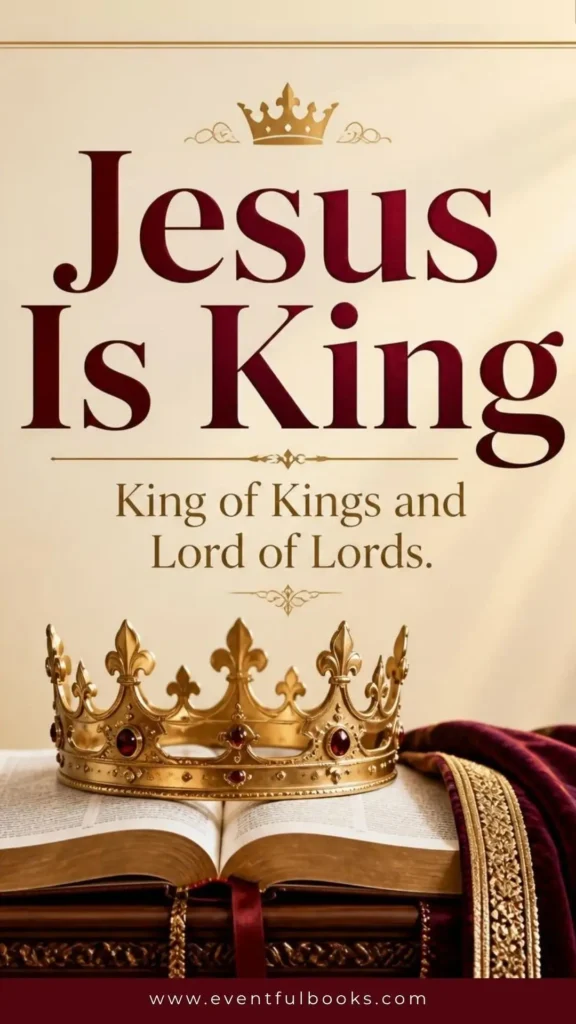
“And he hath on his vesture and on his thigh a name written, KING OF KINGS, AND LORD OF LORDS.”
Revelation 19:16
“Vesture” simply means His robe or clothing. “Hath” is just an old form of “has.” So in modern English, the verse is essentially saying: He has a name written on his robe and on his leg — King of kings, and Lord of lords.
This verse comes near the end of the Bible, in a vision the apostle John received about the future — specifically, a scene depicting Jesus returning in glory at the end of time.
In this vision, Jesus is pictured as a triumphant warrior-king riding out to defeat evil once and for all. This particular verse zooms in on His clothing: written across His robe and thigh is a title identifying exactly who He is.
Ancient kings and generals often had their names or titles inscribed on their armor, banners, or clothing so people would recognize their authority on sight — it’s the same idea as an army flag or a royal seal.
What’s striking here is where the title is written: not just on His robe (something people would see from a distance) but on His thigh — the part of a warrior most visible when mounted on a horse, riding toward you.
It’s a deliberately unmistakable, larger-than-life image: this isn’t a subtle or symbolic kingship, it’s meant to be seen up close and impossible to deny, from every angle, by everyone.
2. Jesus Is King | Matthew 2:2
“Saying, Where is he that is born King of the Jews? for we have seen his star in the east, and come to worship him.”
Matthew 2:2
This verse is set right after Jesus’s birth in Bethlehem. A group of wise men (often called “Magi”) — likely astrologers or scholars from a region east of Israel, possibly Persia or Babylon — had been tracking an unusual star and believed it signaled the birth of a significant king.
Their journey leads them to Jerusalem, where they show up at King Herod’s court asking a very pointed, public question: where can they find the child who has been born King of the Jews.
Herod was the current, reigning king at the time — a ruler backed by Rome, sitting in the actual seat of political power in Jerusalem. And these travelers walk straight into his court and openly ask where the “true” king can be found.
That’s not a small or safe question to ask a paranoid, powerful ruler — later in this same chapter, Herod responds with lethal fear over the threat to his throne.
3. Jesus Is King | 1 Timothy 6:15
“Which in his times he shall shew, who is the blessed and only Potentate, the King of kings, and Lord of lords;”
1 Timothy 6:15
“Shew” is just an old spelling of “show.” “Potentate” means a ruler with great power or authority — basically, a supreme sovereign. So in modern English: God will show this in his own timing — he is the blessed and only Ruler, the King of kings, and Lord of lords.
This verse comes from a letter the apostle Paul wrote to Timothy, a young pastor he had mentored and left in charge of the church in Ephesus.
In this closing section of the letter, Paul is charging Timothy to stay faithful and keep his mission pure until Jesus returns.
In the middle of that charge, Paul breaks into what reads almost like a burst of praise — describing God in exalted, majestic terms as the one who will one day reveal Christ’s return at the appointed time.
Timothy was likely facing pressure, opposition, and the temptation to compromise his faith to fit in with the culture around him. Paul’s response isn’t more strategy or advice — it’s to remind Timothy who’s actually in charge of history.
The point isn’t abstract theology; it’s practical reassurance: no earthly ruler, empire, or pressure Timothy faces can outrank the One who holds ultimate authority over everything, including the exact timing of when Jesus will return.
4. Jesus Is King | Luke 1:32-33
“He shall be great, and shall be called the Son of the Highest: and the Lord God shall give unto him the throne of his father David: And he shall reign over the house of Jacob for ever; and of his kingdom there shall be no end.”
Luke 1:32-33
“The throne of his father David” is a reference to King David, one of Israel’s most famous ancient kings — the angel is saying Jesus will inherit David’s royal line. “The house of Jacob” refers to the people of Israel, tracing back to Jacob (also called Israel) in the Old Testament.
This scene takes place before Jesus is even born. The angel Gabriel appears to a young woman named Mary in Nazareth to tell her she will conceive and give birth to a son.
This verse is part of Gabriel’s announcement, describing exactly who this child will grow up to be — not just a son, but someone who will inherit a royal legacy and reign forever.
Centuries earlier, God had made a promise to King David that one of his descendants would sit on an everlasting throne (2 Samuel 7:12-16) — a promise Israel had been waiting on for roughly a thousand years, through the rise and fall of empires, exile, and foreign occupation.
Gabriel is telling Mary that this ancient, long-awaited promise is finally about to be fulfilled — in her own body, in her own lifetime, through an ordinary young woman in an unremarkable town. The scale of that claim, delivered so quietly to one person, is part of what makes it so striking.
5. Jesus Is King | Zechariah 9:9
“Rejoice greatly, O daughter of Zion; shout, O daughter of Jerusalem: behold, thy King cometh unto thee: he is just, and having salvation; lowly, and riding upon an ass, and upon a colt the foal of an ass.”
Zechariah 9:9
“O daughter of Zion” and “O daughter of Jerusalem” are poetic ways of addressing the city and its people, not literal daughters. “Lowly” means humble. “Ass” and “colt the foal of an ass” both refer to a young donkey.
So in modern terms: Celebrate greatly, people of Jerusalem! Your king is coming to you — righteous, bringing salvation, humble, and riding on a donkey, on a young donkey.
This verse comes from the Old Testament book of Zechariah, written by a prophet speaking to the people of Israel roughly 500 years before Jesus was born describing a prophecy about a future king who would come to Jerusalem.
Kings in the ancient world rode horses into cities as displays of military strength and conquest — a donkey was the opposite, a symbol of peace and humility. Zechariah is describing a king who arrives not to conquer by force, but in gentleness.
Centuries later, Matthew’s Gospel (21:1-5) explicitly points back to this exact prophecy when describing Jesus’s entry into Jerusalem on a donkey right before His crucifixion.
6. Jesus Is King | John 18:37
“Pilate therefore said unto him, Art thou a king then? Jesus answered, Thou sayest that I am a king. To this end was I born, and for this cause came I into the world, that I should bear witness unto the truth. Every one that is of the truth heareth my voice.”
John 18:37
This scene takes place during Jesus’s trial, right before His crucifixion. He’s standing before Pontius Pilate, the Roman governor with authority to sentence Him to death.
Pilate has just asked Jesus directly whether He is a king — since claiming kingship under Roman rule could be treated as treason. Jesus’s answer is careful, but it doesn’t dodge the question.
Jesus, standing powerless and about to be killed, redefines what His “kingdom” actually is: not territory or armies, but truth itself, and people’s willingness to recognize and follow it.
This is the moment His own words finally settle a question hanging over the entire Gospel — is He a king? — and His answer reframes the entire idea of what kingship even means, right in front of the one person who has the legal power to kill Him for saying yes.
7. Jesus Is King | Philippians 2:9-11
“Wherefore God also hath highly exalted him, and given him a name which is above every name: That at the name of Jesus every knee should bow, of things in heaven, and things in earth, and things under the earth; And that every tongue should confess that Jesus Christ is Lord, to the glory of God the Father.”
Philippians 2:9-11
This passage comes from a letter Paul wrote to the church in Philippi, a city he had a close, warm relationship with. Just before this verse, Paul describes how Jesus humbled Himself — taking on human form and even going as far as dying on a cross.
After describing that humility and death, Paul describes God’s response — lifting Jesus up to the highest possible place of honor.
Jesus goes from equality with God, to taking human form, to the lowest possible point (death on a cross, the Roman Empire’s most shameful execution method), and then is raised to the highest possible point.
His kingship and exaltation came through humility and suffering, not around it. Paul also deliberately uses language reserved for God directly to Jesus, making one of the boldest statements about His identity anywhere in the New Testament.
8. Jesus Is King | Isaiah 9:6-7
“For unto us a child is born, unto us a son is given: and the government shall be upon his shoulder: and his name shall be called Wonderful, Counsellor, The mighty God, The everlasting Father, The Prince of Peace. Of the increase of his government and peace there shall be no end, upon the throne of David, and upon his kingdom, to order it, and to establish it with judgment and with justice from henceforth even for ever. The zeal of the LORD of hosts will perform this.”
Isaiah 9:6-7
This prophecy comes from the Old Testament book of Isaiah, written centuries before Jesus’s birth, during a time when Israel faced real threats from surrounding empires.
In the middle of describing coming darkness and hardship, Isaiah shifts into a prophecy of hope — describing a child who will be born, whose government and reign will bring lasting peace and justice.
Isaiah isn’t just predicting a good, wise ruler; he’s describing someone whose identity blurs the line between human king and God Himself, centuries before anyone had a framework for how that could be possible.
This tension — a child who is also somehow “Mighty God” — is exactly the kind of claim that later gets fully unpacked in the New Testament through Jesus, but it’s worth sitting with how strange and bold this prophecy would have sounded to its original audience, long before there was any explanation for how a baby could carry a title like that.
9. Jesus Is King | Daniel 7:13-14
“I saw in the night visions, and, behold, one like the Son of man came with the clouds of heaven, and came to the Ancient of days, and they brought him near before him. And there was given him dominion, and glory, and a kingdom, that all people, nations, and languages, should serve him: his dominion is an everlasting dominion, which shall not pass away, and his kingdom that shall not be destroyed.”
Daniel 7:13-14
This passage comes from a vision the prophet Daniel received while living in exile in Babylon, centuries before Jesus was born.
In the vision, Daniel watches a heavenly scene unfold: a figure described as “one like a son of man” approaches God (referred to as “the Ancient of days”) and is given something extraordinary — authority, glory, and a kingdom that will never end.
The title “Son of man” becomes one of Jesus’s own favorite ways to describe Himself throughout the Gospels — He uses it far more than any other title for Himself.
To modern ears it can sound humble, almost ordinary, but in this context it’s the opposite: it’s describing a figure who receives worship, eternal authority, and a kingdom that spans every nation, directly from God’s own throne room.
10. Jesus Is King | John 1:49
“Nathanael answered and saith unto him, Rabbi, thou art the Son of God; thou art the King of Israel.”
John 1:49
This scene happens very early in Jesus’s public ministry, right at the beginning of John’s Gospel. Jesus has just started gathering His first disciples.
One of them, Philip, goes to find his friend Nathanael and tells him they’ve found the one Moses and the prophets wrote about.
Nathanael is initially skeptical, but when he actually meets Jesus, something about the encounter immediately convinces him — and he responds with this declaration.
What makes this moment stand out is how fast Nathanael arrives at this conclusion — this isn’t a declaration made after years of watching Jesus perform miracles or teach; it happens at their very first meeting.
It’s a small window into a pattern that shows up again and again in the Gospels: people who encounter Jesus directly often arrive at conclusions about who He is far more quickly, and far more boldly, than we might expect.
Yes, the Bible says Jesus is a king! It’s actually one of the clearest, most repeated truths in all of Scripture.
From an Old Testament prophecy about a humble king riding in on a donkey, all the way to Revelation calling Him “King of Kings and Lord of Lords,” the whole Bible points to the same answer.
Kind of — but on His own terms. When Pilate flat-out asked Him if He was a king, Jesus said yes, but then explained His kingdom wasn’t about power or politics — it was about truth.
He also loved calling Himself the “Son of Man,” a title that ties back to an Old Testament vision of someone given an everlasting kingdom. So He didn’t shy away from it, He just made sure people understood what kind of King He really was.
Most Christians believe God the Father and Jesus the Son are both fully God, equal, not one ranked above the other — this is what’s called the Trinity.
At the same time, the Bible does talk about Jesus humbling Himself and submitting to the Father while He was here on earth. So it’s not really a “who wins” situation — it’s more like two sides of the same beautiful mystery, and honestly, people have been reflecting on it for centuries.
You can pray to both God or Jesus! Since Christians believe God the Father, Jesus, and the Holy Spirit are all one God, praying to either is biblically supported.
A lot of people follow the pattern Jesus Himself taught — praying to the Father, in Jesus name — but plenty of believers pray directly to Jesus too, and there are examples of that in Scripture as well. There’s no wrong way here, just whatever feels most natural in your walk with Him 💛