The Ancient Way Monks Use to Actually Hear God When You Read the Bible (And You Can Too)
Have you ever wondered how to read the bible in a way that you can not only understand what is happening and what it means but also, but also feel like it’s speaking directly into your life, not just the past?
Did you know there’s a version of Bible reading most of us have never been taught?
Not the “read a chapter, check the box” kind. Not the kind where you’re skimming for facts so you can say you did your devotion today.
A slower, older kind — one monks have quietly practiced behind monastery walls for over 1,500 years, long before “quiet time” was ever a phrase.
It’s called Lectio Divina — Latin for “divine reading” — and it’s less a study method and more a conversation.
Instead of reading the Bible about God, you read it with Him. And once you learn the simple rhythm behind it, it’s almost impossible to go back to reading Scripture the old way.
What Is Lectio Divina, Exactly?
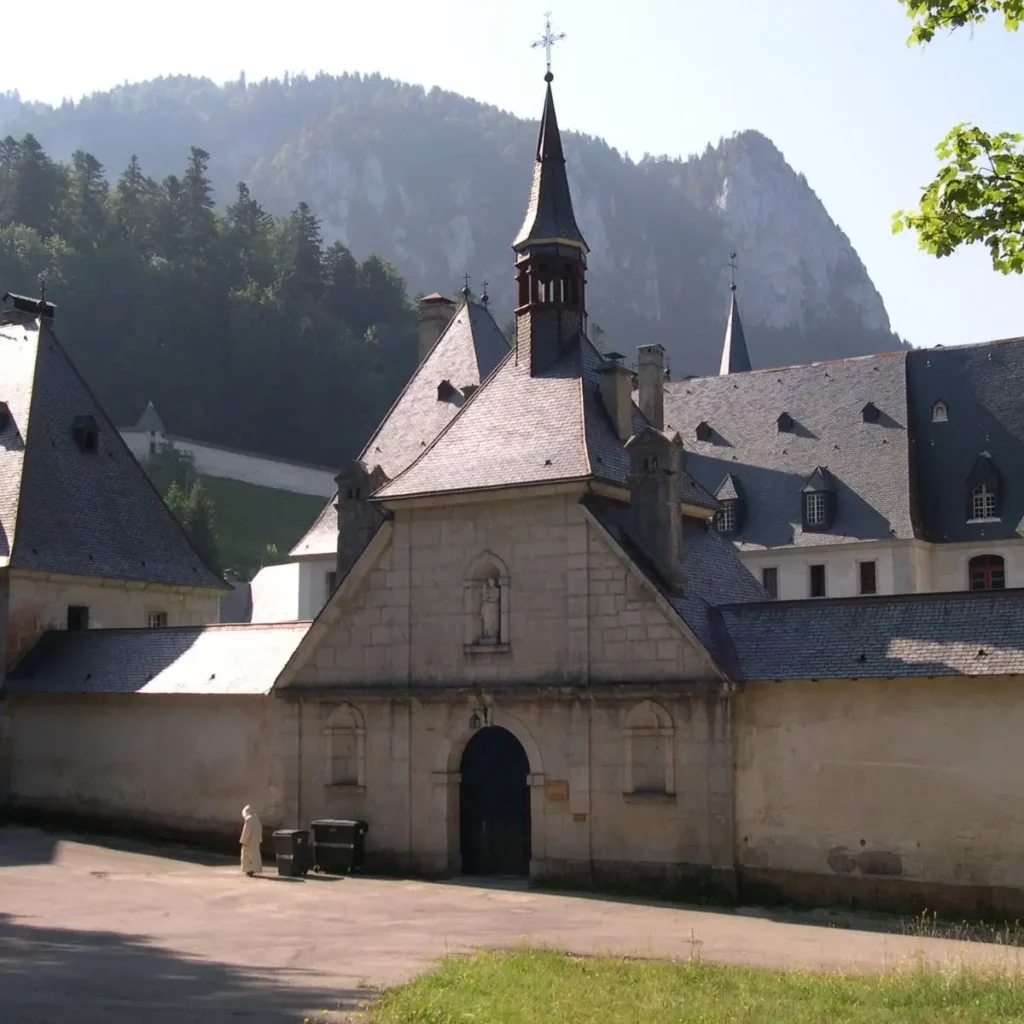
Lectio Divina goes back to St. Benedict in the 6th century. He wrote a guidebook for how monks should live their daily lives, and in it, he told them to set aside hours each day just to read Scripture slowly and prayerfully — long before anyone had a name for it.
Six centuries later, a Carthusian monk named Guigo II gave it real shape at the Grande Chartreuse monastery in the French Alps, describing it as a ladder in a letter he titled The Ladder of Monks — each rung lifting you a little closer to God:
“Seek in reading and you will find in meditation; knock in prayer and it will be opened to you in contemplation.”
For most of its history, this practice stayed almost entirely behind monastery walls — something monks did in silence, largely unknown to ordinary believers.
It wasn’t until the 20th century that the Church actively encouraged every Christian — not just monks and nuns living in monasteries — to take up this practice.
Pope Benedict XVI wrote about it directly in a major 2010 document called Verbum Domini, urging ordinary believers to make it part of their own prayer life.
He called Sacred Scripture read this way a place where “the person reading hears God who is speaking, and in praying, responds to him.”
Why does it actually work, when just “reading more” doesn’t?
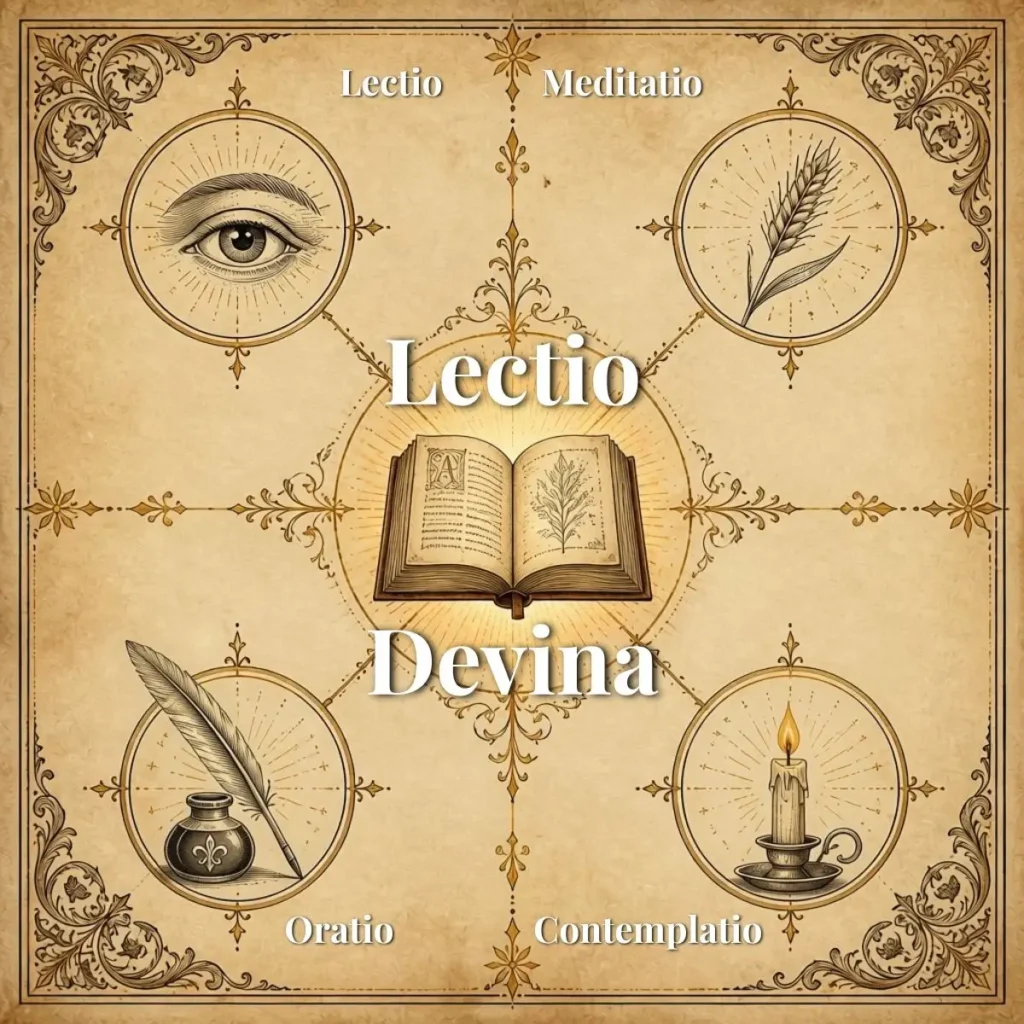
Skimming a passage for facts engages your mind. Lectio Divina engages your whole attention — your senses, your memory, your emotions, your will — the same way a real conversation with someone you love does.
You can’t skim a conversation. The four steps simply give that kind of attention a repeatable shape: read to listen, reflect to absorb, respond to be honest, rest to receive. Nothing is rushed, because transformation was never a fast process to begin with.
And this is the part Church teaching is careful to protect: contemplatio, the deepest movement of the four, can’t be forced. It’s described as a gift, not a reward for effort — something God gives when and how He chooses, not something you unlock through the right technique.
That should actually be a relief. You’re not failing at Lectio Divina if you don’t feel a lightning bolt of peace every time. You’re simply making space and showing up. The rest isn’t up to you.
But here’s the key difference between Lectio Divina and ordinary Bible study: Bible study asks, “What does this passage mean?” Lectio Divina asks, “What is God saying to me, right now, through this passage?”
One is analysis and the other is intimacy — and Pope Benedict XVI went so far as to say this process isn’t even finished until it produces actio, a changed life poured out for others. Not more Bible knowledge. An actual, different person.
It’s not about covering more ground. It’s about actually meeting God in the text. So what are the steps of Lectio Divina?
The 4 Steps of Lectio Divina (Explained Simply)
1. Lectio — Read
Choose a short passage — a handful of verses is plenty, sometimes even one or two is enough.
Read it slowly, ideally out loud. Not to finish it, but to hear it, the way you’d listen to someone speak rather than scan a memo. Then read it a second time, slower still.
Somewhere in that second pass, a single word or phrase usually catches on something in you — not because you went looking for it, but because it simply refused to slide past.
This is the step where most beginners quietly give up, and almost always for the same reason: they open to an unfamiliar passage, hit a name, a custom, or a phrase they don’t understand, and the whole moment of stillness collapses into confusion instead of connection.
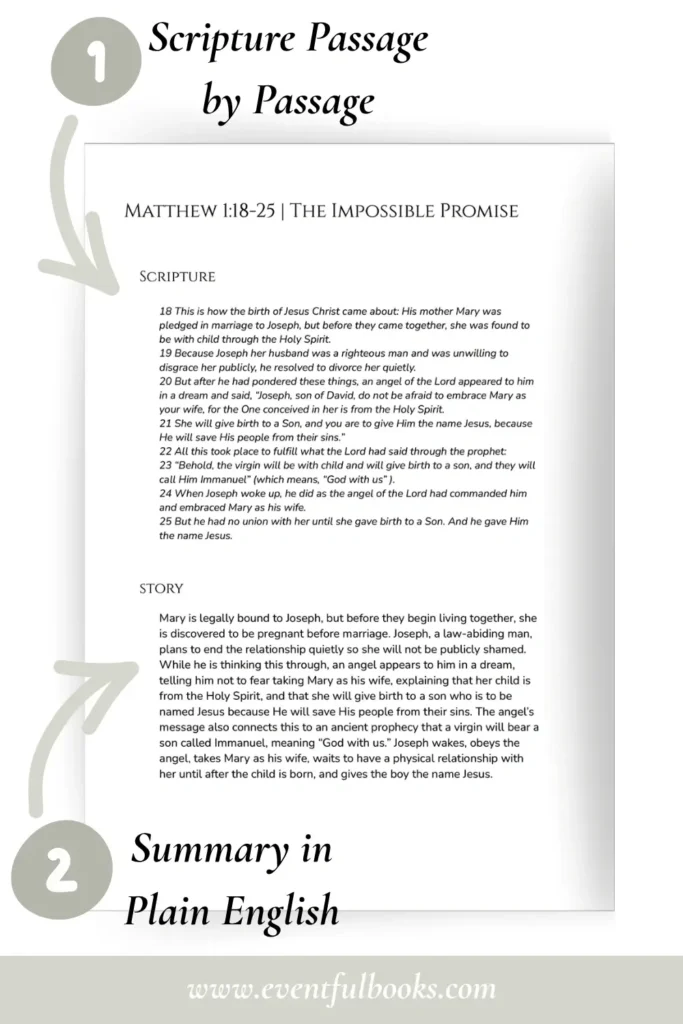
You can’t listen for a whisper while you’re busy squinting at a foreign word.
A little context before you slow down changes everything — knowing who’s speaking, why, and to whom means you can actually rest in the passage instead of decoding it.
This is exactly what our guided Gospel study books were built to do — giving you each day’s passage explained in plain-English alongside the actual scripture, so Lectio can start where it’s supposed to: with listening, not decoding.
2. Meditatio — Reflect
Now stay with the word or phrase that caught your attention. Don’t rush to define it — chew on it instead, the way the early monks described it: like an animal quietly working over its food, drawing out the nourishment a little at a time.
Ask what it means, why it stood out today of all days, and where it touches your actual life — a decision you’re avoiding, a relationship that’s strained, a fear you haven’t said out loud yet.
Say the word that struck you was simply “peace.” One person might sit with it and think of a conflict they’ve been avoiding making right. Another might realize how rarely they feel it, even in a full and busy life.
Same word, same passage — completely different meeting with God, because meditatio isn’t about arriving at the “correct” interpretation. It’s about letting the text find the exact place it needs to meet you.
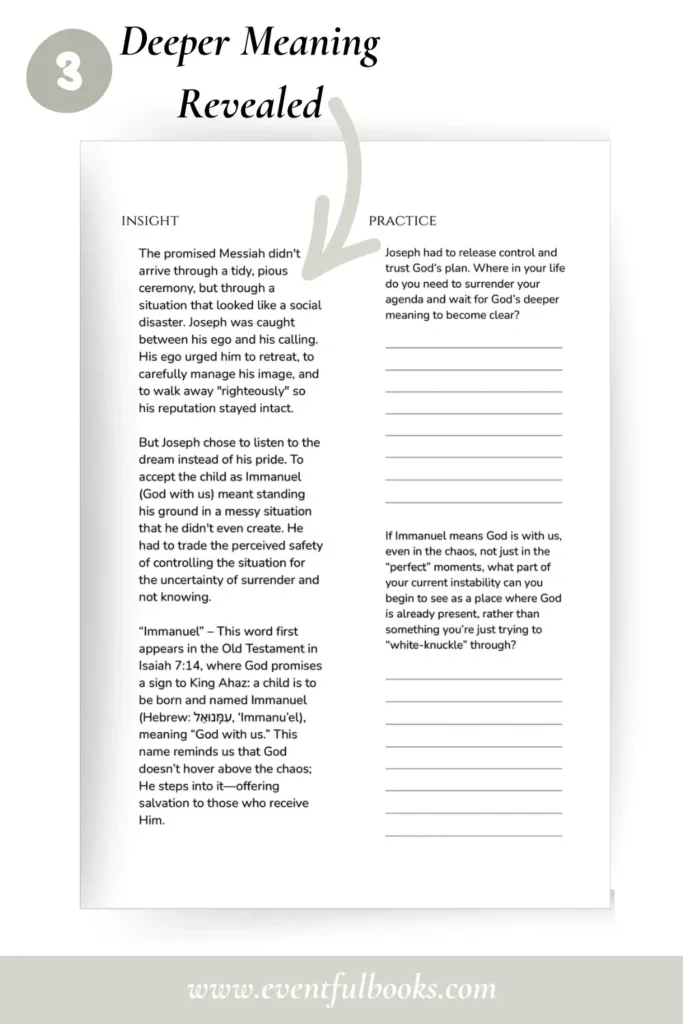
This is also where beginners often stall — you notice a phrase, sit with it for thirty seconds, and then your mind goes blank or wanders to your to-do list. That’s not a failure of faith; it’s just a lack of a little structure.
Knowing the history, the culture, or the original weight behind a phrase gives your reflection somewhere to go instead of running dry.
It’s why every day in our guided Gospel study books includes a deeper insight section — just enough background to help meditatio actually deepen, rather than stalling out after a single thought.
3. Oratio — Respond
Talk to God about what just surfaced. Not a formal, polished prayer — an honest one.
Tell Him what the passage stirred, what it’s asking of you, where you feel resistance, conviction, gratitude, or relief.
This can be petition, thanksgiving, confession, or simply naming what’s true right now. There’s no wrong way to say it, as long as you actually say it instead of just thinking it.
If words don’t come easily, that’s more common than you’d think — plenty of people find silence or a single honest sentence (“Lord, I don’t know what to do with this yet”) is oratio enough.
What matters isn’t eloquence, it’s honesty. This is also the step where writing changes everything.
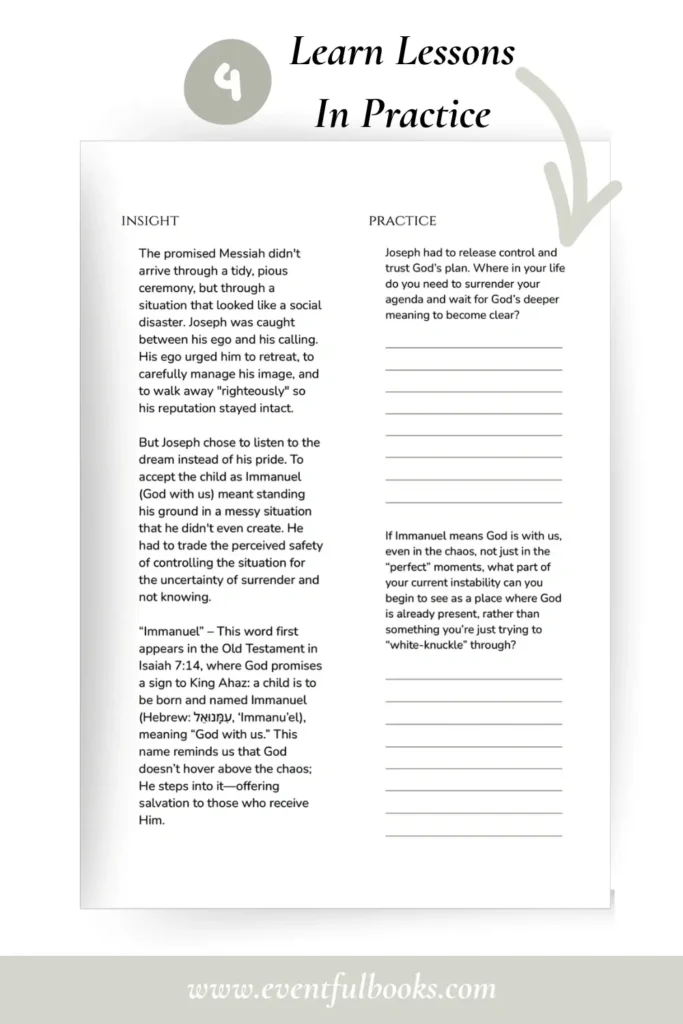
A thought that stays in your head tends to evaporate by lunchtime; a thought you put into words on a page has a way of sticking around, resurfacing days later exactly when you need it.
That’s precisely why we build a reflection section with two simple, direct questions — and blank lines to actually write your answers — into every day of our guided studies.
Oratio isn’t meant to stay in your head. Putting it on paper turns a fleeting thought into an honest conversation with God you can actually look back on.
4. Contemplatio — Rest
Finally, stop talking. Stop analyzing. Just rest in God’s presence, without needing words, resolutions, or answers.
This is the step that trips up modern readers most, because we’re so used to productivity that “doing nothing” in prayer can feel like failing at it. It isn’t.
Contemplatio isn’t a blank space to fill — it’s the whole point the other three steps were quietly building toward: simply being with God, the way you’d sit in comfortable silence with someone you trust completely, no performance required.
Remember too that this step can’t be manufactured. If you don’t feel some deep, sweeping peace every time you sit down, you haven’t done it wrong — you’ve simply shown up, which is all that’s actually asked of you.
Some traditions add a fifth step here, Actio, carrying what you received out into your day in some small, concrete act of love.
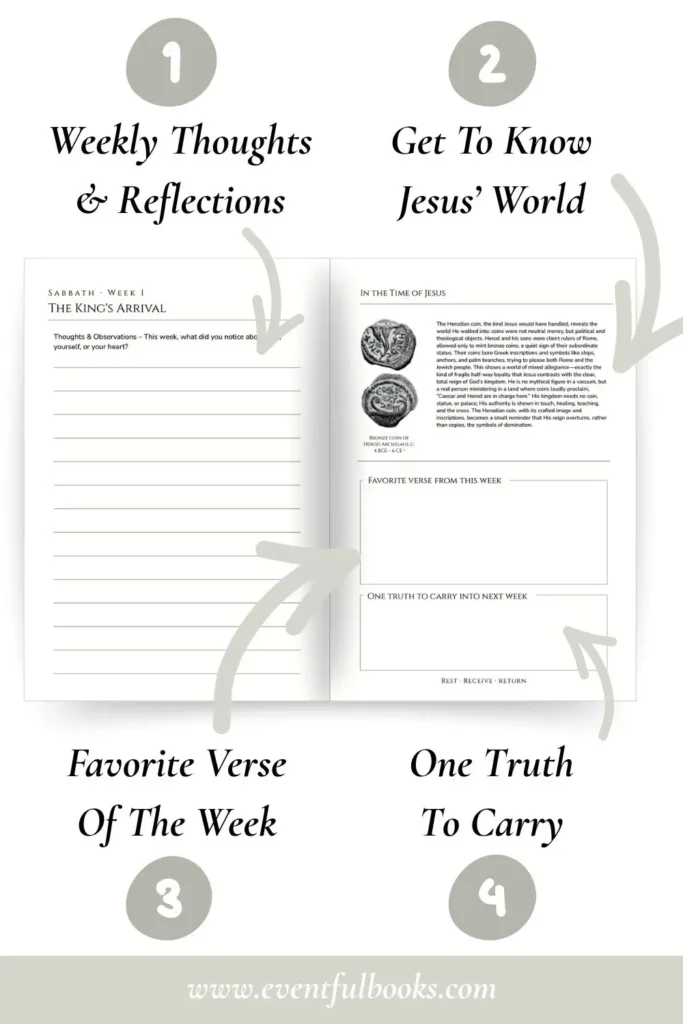
A daily practice naturally builds toward a weekly one, too. That’s the whole heart behind the Sabbath spread in our guided study books — a seventh day set apart from the other six, built entirely for rest and reflection instead of more reading.
Room for longer notes on your week, a section to get to know Jesus’s world a little better through the places and artifacts of His time, a favorite verse to hold onto, and one truth to carry forward.
It’s contemplatio, given a full day instead of a few borrowed minutes — a built-in exhale at the end of every week.
Why This Practice Works So Well With the Gospels
The Bible isn’t just one book — the Bible is a library of 66 books, written across roughly 1,500 years, in three different languages, spanning law, poetry, prophecy, letters, and history. That’s exactly why it’s so rich.
But it’s also exactly why so many people open a Bible for the first time, land somewhere unfamiliar — a genealogy, a wall of Levitical law, a prophet mid-oracle — and quietly close it again, assuming the problem is them.
If you’re just starting out, or coming back after time away, the Gospels are the natural place to begin.
If you start here, the rest of the Bible will have a center of gravity to orbit around instead of feeling like scattered, disconnected pieces.
Lectio Divina can be done with any Scripture, but the Gospels have a special place in the practice for exactly this reason.
You’re not just reading about God, you’re sitting with the actual words, actions, and presence of Jesus.
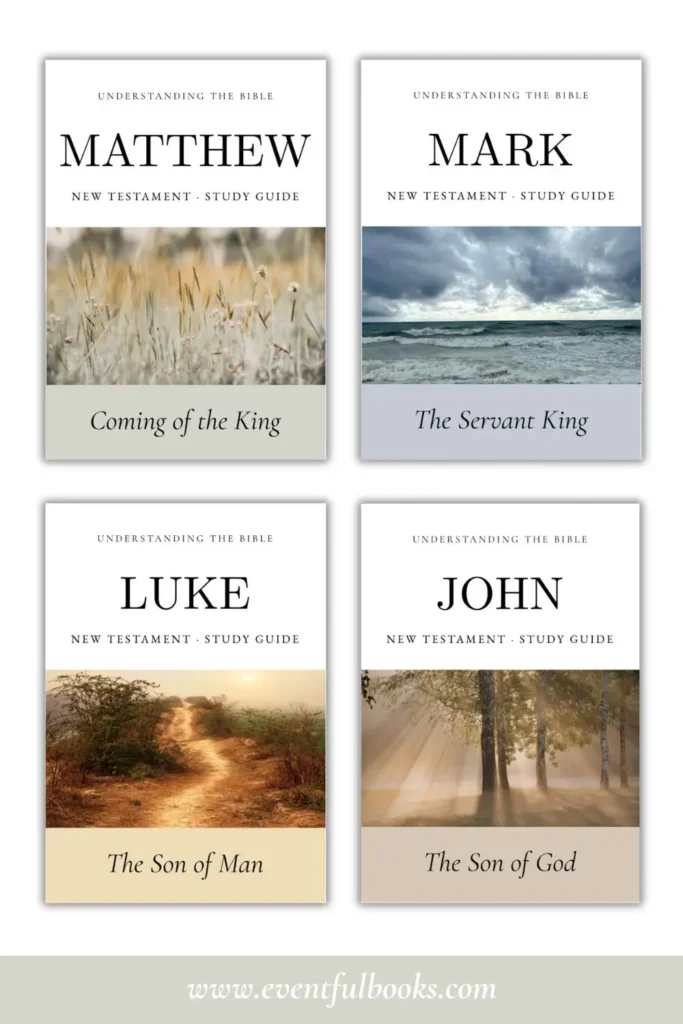
That’s part of why we chose to build our guided study series Gospel by Gospel — Matthew, Mark, Luke, and John.
Each one giving you a slow, steady path through the life of Jesus using this same rhythm of read, reflect, respond, rest.
How to Start Practicing Lectio Divina Today
You don’t need anything fancy — just a quiet ten minutes, an open Bible, and a willingness to slow down.
- Pick a short Gospel passage (a parable, a healing story, a handful of verses from the Sermon on the Mount).
- Read it twice, slowly.
- Notice the word or phrase that catches you.
- Sit with it. Ask what it’s saying to you today.
- Talk to God about it — out loud or on paper.
- Rest quietly for a minute or two before you go about your day.
If you’d rather not choose a passage cold each day, that’s exactly why we built our guided Gospel study books — the passage, context, and reflection questions are already laid out for you, so all you have to bring is yourself.
Once you slow down enough to actually practice Lectio Divina, it’s hard to imagine reading the Bible any other way. If you’d like a little structure to help the rhythm stick — the passage, the context, room to reflect, and a built-in day of rest each week — take a look at our guided Gospel study series. It was built for exactly this.