


Gospel of Luke Bible Study Guide – Daily Workbook and Interactive Bible Journal
$9.99
This interactive workbook was created for every reader who has meant to study the Bible properly but never had someone walk through it with them. It takes you through the entire Gospel of Luke, the longest of the four Gospels, in manageable passages. Along the way you’ll meet the stories only Luke tells, such as the Good Samaritan and the Prodigal Son. Each passage is explained in plain English, with no theological background required, and each day ends with honest reflection questions that help you carry what you’ve read into your actual life.
What’s inside
- A complete passage-by-passage study of the Gospel of Luke, so nothing gets skipped and nothing gets rushed
- Every daily study contains: the full Scripture text, plain-English context, deeper spiritual insight, and honest reflection questions
- A six-day study rhythm with a Sabbath reflection: flexible for busy lives, and never a schedule you can fail
- Works solo or as a small group study, with reflection questions designed for personal growth or weekly discussion
- Part of the New Testament Study Guide series: Book-by-Book through the Bible
Specifications:
Paperback · Ebook · PDF · Paperback · Hardcover · Kindle | 219 pages | 7 x 10 inches | Color: Black & White | Scripture text: Curated World English Bible (WEB)
Description
Why Study the Book of Luke?
You should study the book of Luke because it gives you a carefully researched account of Jesus’ life you can trust, shows God’s mercy for people who feel overlooked, and teaches you to pray and depend on God as Jesus did.
It helps you know the truth with certainty. Luke wrote as a careful investigator. He explains that he “traced the course of all things accurately from the first” (Luke 1:3) so that his reader “might know the certainty” of what they had been taught (Luke 1:4). If you want to be sure about who Jesus is and what He came to do, Luke’s Gospel was written with you in mind.
It shows God’s heart for the lost. Luke sums up God’s plan in one sentence: “The Son of Man came to seek and to save that which was lost” (Luke 19:10). Again and again, Jesus Christ welcomes the people others overlooked: sinners, outsiders, the poor, and the forgotten. It’s a Gospel full of mercy, forgiveness, and grace, and it includes some of the best-loved parables Jesus ever told.
It teaches you to pray. Luke shows Jesus at prayer more often than any other Gospel does, and the Holy Spirit is at work from the very first chapter. Studying Luke slowly, passage by passage, draws you into that same life of prayer, and strengthens your faith through an account built on eyewitness testimony.
If you’ve ever wondered whether there’s room for you in God’s story of salvation, Luke’s answer is a resounding yes.
What’s Inside This Gospel of Luke Bible Study Guide?
A complete, day-by-day Bible study through all 24 chapters of Luke, with everything you need for each lesson in one place.
What Are the Key Features of This Gospel of Luke Study Guide?
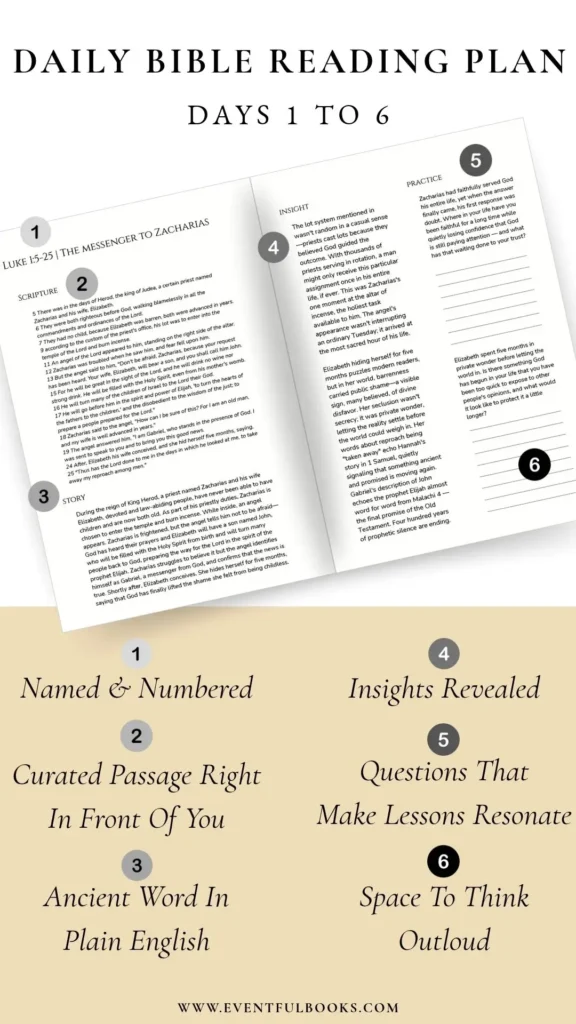
- Every chapter, in order. The guide takes you through Luke’s Gospel in short, manageable passages, from the birth announcements in chapter 1 to the empty tomb in chapter 24. No prior Bible knowledge needed.
- One spread per day. The full Scripture text, a plain-English explanation, and commentary-style insight sit side by side, so there’s no flipping between books or searching online for background.
- A pace that fits real life. Six days of study and a Sabbath reflection make up each week. If life gets busy, simply pick up where you left off. There’s no schedule to fall behind on.
- For beginners, individuals, and groups. Use it on your own as a personal Bible study, or bring the reflection questions to your weekly small group.
What Each Daily Gospel of Luke Reading Plan Includes
- The Passage: each day’s reading, printed in full from the World English Bible (WEB). Just open the workbook and begin.
- In Plain English: a clear explanation of what’s happening, who’s involved, and why it matters.
- Going Deeper: the historical background, cultural context, and spiritual insight that bring each passage to life. It’s like having a short commentary on the page.
- Reflect: honest questions to help you notice what the text says and consider what it means for your life today.
Sabbath Reflection: Walk Through Luke’s World
Every seventh day is a chance to pause and take in the bigger picture. Each Sabbath reflection includes:

- A full page to reflect more deeply on the week’s reading
- A closer look at artefacts and important places from Jesus’ world, from the towns of Judea and Galilee to Jerusalem and the Temple, where Luke’s Gospel both begins and ends
- Space to write down your favourite verse of the week
- One thing to carry forward into the days ahead
Why is the Book of Luke so important in the Bible?

The book of Luke is important because it gives the fullest account of Jesus’ life, contains many of Christianity’s best-loved stories, and, together with Acts, connects the life of Jesus to the birth of the early church.
It’s the fullest account of Jesus’ life. Luke is the longest book in the New Testament, and he wrote it as a carefully researched account, from the announcement of Jesus’ birth to His ascension into heaven.
Many of Christianity’s best-loved stories appear only in Luke. These include the angel’s visit to Mary, the shepherds at Bethlehem, the Good Samaritan, and the Prodigal Son. Without Luke, the Christmas story as most people know it wouldn’t exist.
It bridges Jesus and the early church. Luke is the only Gospel with a sequel, the book of Acts, which continues the story from Jesus’ ascension to the spread of the gospel across the Roman world. Together, Luke and Acts make up roughly a quarter of the New Testament, more than any other author, including Paul.
It shows God’s plan unfolding through history. Luke traces how God’s promises in the Old Testament are fulfilled in Jesus and then carried to the ends of the earth.
What Is the Purpose of Luke’s Gospel?
The purpose of Luke’s Gospel is to give readers certainty that their faith in Jesus rests on reliable, carefully investigated events, and to show that God’s salvation is for everyone, not just for Israel.
To give certainty. Luke states this purpose in his opening lines to Theophilus. He wrote “that you might know the certainty concerning the things in which you were instructed” (Luke 1:4). Luke wanted his readers to be confident that what they believed was based on real events, carefully researched and drawn from eyewitnesses.
To show that salvation is for all people. When the elderly Simeon holds the baby Jesus in the Temple, he praises God for a salvation prepared “before the face of all peoples; a light for revelation to the nations” (Luke 2:31–32). That theme runs through the whole book, as Jesus welcomes Gentiles, Samaritans, sinners, and outsiders.
What Are the Main Themes of Lukes Gospel?
The main themes of Luke’s Gospel include:
- Salvation for all: Jesus came for Jews and Gentiles, rich and poor, insiders and outsiders.
- God’s plan fulfilled: Luke shows how events unfold just as God promised, from the prophets to the cross.
- The Holy Spirit: The Spirit is active from the first chapter, filling John the Baptist, Elizabeth, and Zechariah, and empowering Jesus’ ministry (Luke 4:18).
- Prayer: Luke shows Jesus praying at every turning point, from His baptism to the cross.
- Mercy, forgiveness, and repentance: In Luke 15, the parables of the lost sheep, the lost coin, and the lost son all celebrate God’s joy over one sinner who repents.
- Good news for outsiders: Women, the poor, tax collectors, sinners, and even Samaritans receive Jesus’ attention and grace.
- Gods kingdom: Jesus proclaims the arrival of God’s kingdom, which turns the world’s values upside down.
- Jerusalem and the Temple: The Gospel begins with Zechariah serving in the Temple and ends with the disciples worshipping there (Luke 24:53). Jesus’ long journey to Jerusalem shapes the whole middle of the book.
How Is Luke Different from the Other Gospels?
The main difference is that Luke is written as a carefully researched history for a Gentile audience, presenting Jesus as the Saviour of all people, not only of Israel.
Luke is one of the three Synoptic Gospels, along with Matthew and Mark, which share much of the same material and order. Scholars generally believe both Matthew and Luke used Mark as a source.
But where Matthew writes for Jewish readers and Mark gives a fast-paced account of Jesus’ ministry, Luke sets out an orderly, investigated account for a wider world. That focus shapes everything that makes his Gospel distinct:
- A formal preface and dedication. Luke is the only Gospel that opens like a Greek history, explaining its research and dedicating the work to Theophilus (Luke 1:1–4).
- A Gentile author and audience. Traditionally written by a Gentile physician, Luke’s Gospel is addressed to a wider, Greek-speaking audience. Matthew writes with Jewish readers in mind, while Luke often explains Jewish customs and places.
- A different genealogy. Matthew traces Jesus’ family line back to Abraham. Luke traces it all the way back to Adam (Luke 3:38), presenting Jesus as Saviour of all humanity.
- Mary’s perspective. Matthew tells the birth story through Joseph’s eyes. Luke tells it through Mary’s.
- The Sermon on the Plain. Luke’s version of Jesus’ great sermon (Luke 6:17–49) is shorter than Matthew’s Sermon on the Mount and is set on level ground.
- The journey to Jerusalem. Ten chapters (9:51–19:27) frame Jesus’ ministry as a journey towards the cross, and much of this material appears only in Luke.
- Part of a two-volume work. Luke is the only Gospel with a sequel, the book of Acts. Together they make Luke the largest contributor to the New Testament.
Compared with the Gospel of John, Luke is more of a narrative history. It’s full of miracles, parables, and events, while John concentrates on long discourses about who Jesus is.
Who Are the Key People in the Gospel of Luke?
The key people in the Gospel of Luke include:
- Zechariah: an elderly priest who meets the angel Gabriel in the Temple and is struck silent for doubting (Luke 1).
- Elizabeth: Zechariah’s wife, mother of John the Baptist, and relative of Mary. She is filled with the Holy Spirit when Mary visits.
- Mary: the mother of Jesus, whose faith, and whose song of praise known as the Magnificat (Luke 1:46–55), is central to Luke’s opening chapters.
- Gabriel: the angel who announces the births of both John and Jesus.
- John the Baptist: the forerunner who prepares the way for Jesus “in the spirit and power of Elijah” (Luke 1:17).
- Simeon and Anna: two faithful elderly believers who recognise the baby Jesus in the Temple.
- Mary and Martha: sisters who welcome Jesus into their home (Luke 10:38–42).
- Zacchaeus: a tax collector who climbs a tree to see Jesus and is transformed by grace (Luke 19:1–10).
- Cleopas: one of two disciples who meet the risen Jesus on the road to Emmaus (Luke 24).
- Theophilus: the person Luke wrote his Gospel for. His name means “friend of God.”
What Is the Gospel of Luke?
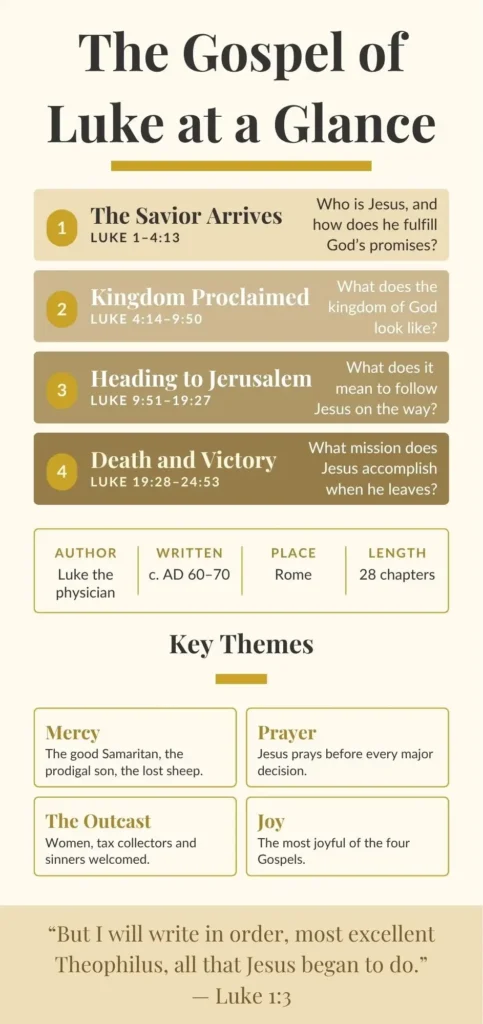
The Gospel of Luke is the third of the four Gospels in the New Testament. Its 24 chapters tell the story of Jesus Christ from the announcement of His birth to His resurrection and ascension. By word count it’s the longest book in the New Testament.
Lukes account moves in a clear order:
- Prologue (1:1–4): Luke explains why and how he wrote.
- Birth and childhood (1:5–2:52): the births of John the Baptist and Jesus.
- Preparation (3:1–4:13): John’s preaching, Jesus’ baptism, and His temptation in the wilderness.
- Ministry in Galilee (4:14–9:50): Jesus’ teaching, miracles, and the calling of His disciples.
- The journey to Jerusalem (9:51–19:27): a long section, unique to Luke, filled with parables and teaching.
- Jerusalem (19:28–24:53): Jesus’ final week, His death, His resurrection, and His ascension.
Who Wrote the Gospel of Luke?
The Gospel of Luke was written by Luke, a physician and travelling companion of the apostle Paul, most likely around AD 80–90.
The Gospel doesn’t name its author, but early church tradition consistently attributes it to St Luke. Paul mentions him in his letters, calling him “Luke the beloved physician” (Colossians 4:14) and a “fellow worker” (Philemon 24). Many scholars believe Luke was a Gentile, which would make him the only non-Jewish author in the New Testament.
Luke wrote both this Gospel and its sequel, the book of Acts, and addressed both to a man named Theophilus. Most scholars date Luke’s writing to around AD 80–90. Some argue for an earlier date in the 60s, since Acts ends with Paul still alive in Rome.
Was Luke one of the twelve apostles?
No. Luke wasn’t one of the twelve apostles, and he probably never met Jesus. His Gospel carries authority because of its close connection to the apostles’ teaching. Luke travelled with Paul, knew the early church leaders, and drew on eyewitness accounts.
Mark, the author of another Gospel, wasn’t one of the Twelve either. The early church accepted both Gospels because they faithfully preserved the testimony of those who had been with Jesus.
How did Luke write his Gospel if he wasn’t there?
Luke tells us himself. In his opening lines he explains that he gathered accounts handed down by “those who from the beginning were eyewitnesses and servants of the word,” and “traced the course of all things accurately from the first” (Luke 1:2–3).
Luke’s account is the work of a careful researcher. Most scholars believe he drew on Mark’s Gospel along with other written and spoken sources. His detailed account of Jesus’ birth may have come from people who were there. Some have suggested Mary herself, since Luke twice notes that she treasured these things in her heart (Luke 2:19, 51). He may also have gathered material while in Judea with Paul.
What happened to Luke after Jesus died?
Luke appears to have become a Christian some years after Jesus’ death and resurrection, probably through the early church’s mission among the Gentiles. In Acts, the narrative switches to “we” in several passages, suggesting Luke joined Paul on parts of his missionary journeys. He stayed with Paul during his imprisonment in Rome. In one of his final letters, Paul writes, “Only Luke is with me” (2 Timothy 4:11).
According to early tradition, St Luke never married and died at the age of 84 in Greece. He is honoured as the patron saint of physicians and artists, and his feast day is 18 October.
What is a famous verse from the Gospel of Luke?
One of the most famous verses in Luke is the angel’s announcement to the shepherds: “I bring you good news of great joy which will be to all the people. For there is born to you today, in David’s city, a Savior, who is Christ the Lord” (Luke 2:10–11). It’s read in churches around the world every Christmas.
Other well-known verses from Luke include:
- “For nothing spoken by God is impossible” (Luke 1:37), Gabriel’s words to Mary.
- “Glory to God in the highest, on earth peace, good will toward men” (Luke 2:14), the song of the angels at Jesus’ birth.
- “As you would like people to do to you, do exactly so to them” (Luke 6:31), Luke’s version of the Golden Rule.
- “The Son of Man came to seek and to save that which was lost” (Luke 19:10), often seen as a summary of the whole Gospel.
- “Father, forgive them, for they don’t know what they are doing” (Luke 23:34), Jesus’ prayer from the cross.
How to Study the Book of Luke?
The simplest way to study the book of Luke is to read one short passage a day and work through four steps: read the text, observe the details, interpret what it means, and apply it to your life. Open each session with prayer, and keep going steadily rather than trying to cover too much at once.
This easy approach works for personal Bible study and for groups, and it’s the rhythm each lesson in this guide follows.
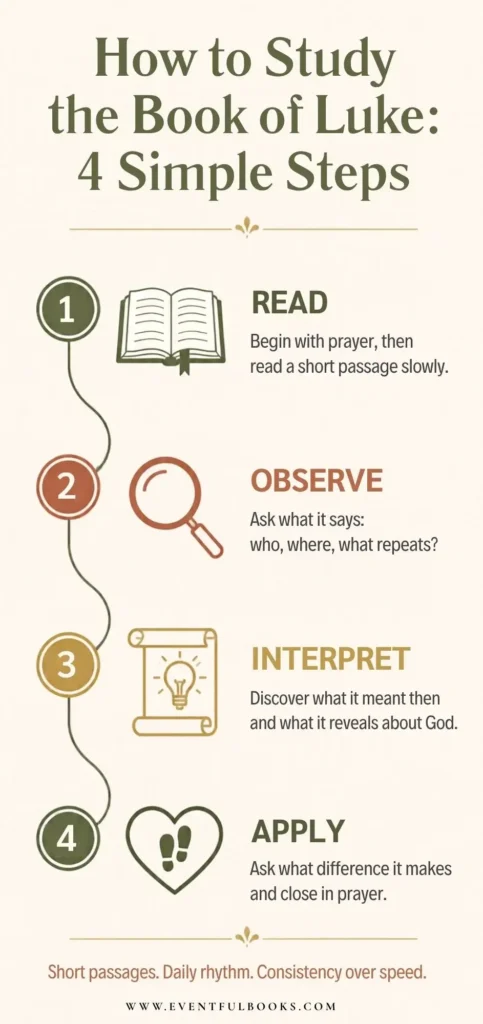
1. Read
Begin by asking God to speak to you through His Word. Luke himself records the disciples asking, “Lord, teach us to pray” (Luke 11:1), so it’s a fitting place to start. Then read the passage through slowly, at least twice. Luke’s Gospel is full of vivid stories, and an unhurried reading helps you notice them.
In this guide: each day’s passage is printed in full, ready to read.
2. Observe
Look closely at what’s actually happening. Who is Jesus with? Who is welcomed and who is left out? Where is He travelling, and how do the crowds, the religious leaders, and His own disciples respond? In Luke, small details, like who Jesus eats with, often carry the biggest meaning.
In this guide: the Reflect questions help you slow down and notice what’s on the page.
3. Interpret
Next, ask what the passage meant to its first readers and what it shows about God’s plan. Good interpretation considers the customs of first-century Judea, the Old Testament promises Luke points back to, and how each passage fits the wider story of Scripture.
In this guide: the In Plain English and Going Deeper sections explain the background and meaning, so each passage makes sense without extra reference books.
4. Apply
Finally, ask what this means for you today. Is there a call to repentance, an invitation to trust, or an example of mercy to follow? Close in prayer, asking God to grow your faith through what you’ve read.
In this guide: honest reflection questions help you live out each passage, and the Sabbath reflection gives you space to look back over the week.
Gospel of Luke Bible Study Guide – Daily Workbook and Interactive Bible Journal
Luke wrote so that his readers could know the truth about Jesus with certainty. This Gospel of Luke Bible study helps you do the same, one short passage at a time. Each day gives you plain-English explanations and honest reflection questions, so you can study at your own pace and see where you fit in God’s story.
Frequently Asked Questions
Is the Gospel of Luke a good place to start reading the Bible?
Yes. Luke wrote for readers who wanted certainty about their faith, and he tells the story of Jesus from the very beginning, in careful order. Its familiar stories, such as the Christmas account and the parable of the Prodigal Son, make it an especially welcoming book for first-time Bible readers.
Did Jesus ever meet Luke?
Probably not. Luke wasn’t one of the twelve disciples and most likely became a believer after Jesus’ resurrection. He based his Gospel on careful research and eyewitness accounts (Luke 1:1–4), and later travelled with the apostle Paul.
Does the Gospel of Luke include the birth of Jesus?
Yes. Luke gives the fullest account of Jesus’ birth in the Bible. Chapters 1 and 2 include Gabriel’s announcements to Zechariah and Mary, Mary’s visit to Elizabeth, the journey to Bethlehem in Judea, the shepherds and angels, and Jesus being presented in the Temple.
Is this study guide tied to a particular denomination?
No. The guide focuses on what the text of Luke says and means, and it’s suitable for readers from any Christian tradition.
Which Bible translation does this study guide use?
Each daily study includes the full Scripture text from the World English Bible (WEB), a modern, readable translation in the public domain. You won’t need a separate Bible, though you’re welcome to read alongside your own translation.
Do I need any prior Bible knowledge?
No. Every passage is explained in plain English, with the historical and cultural background included, so you can follow along whether you’re opening the Bible for the first time or have been reading it for years.
Related products
- Grandma’s Memoirs — A Guided Life Story Journal: Keepsake for Grandmothers to Share Their Life Stories to Pinterest (opens in a new window)

- Spiritual Warfare Prayers: 180 Daily Bible Verse Devotional To Rise Above Spiritual Attack to Pinterest (opens in a new window)
- Aunty’s Memoirs — A Guided Life Story Journal: Keepsake for Aunts to Share Their Life Stories to Pinterest (opens in a new window)






Reviews
There are no reviews yet.