



Gospel of John Bible Study Guide – Daily Workbook and Interactive Bible Journal
$9.99
Have you meant to study the Bible properly but never had someone walk you through it? This Gospel of John Bible study guide does exactly that. It takes you through the entire book of John in short, manageable daily passages, explaining what’s happening in plain English so you can meet Jesus Christ in Scripture for yourself. No theological background needed. Just bring a willingness to read, reflect, and carry what you learn into your everyday life.
- Every passage of the Gospel of John, in order. Nothing gets skipped and nothing gets rushed.
- Made for personal study or a small group Bible study. The reflection questions work for quiet time alone or weekly discussion.
- Who it’s for: individuals, small groups, Sunday school classes, new believers, Bible journalers, and longtime readers who want to slow down and go deeper.
- Part of the New Testament Study Guide series: Book-by-Book through the Bible.
Specifications:
Ebook · PDF · Paperback · Hardcover · Kindle | 191 pages | 7 x 0.44 x 10 inches | Color: Black & White | Scripture text: Curated World English Bible (WEB)
Description
Why Study the Gospel of John?
Of the four Gospels, John is the one that tells you exactly why it was written: “that you may believe that Jesus is the Christ, the Son of God, and that believing you may have life in his name” (John 20:31).
Every chapter of John’s Gospel serves that purpose. From the opening lines about the eternal Word to the empty tomb, John sets out to show who Jesus Christ is: the promised Messiah, the Son of God, and the source of eternal life. It’s no surprise that the book of John is so often the first book recommended to new readers, and one that longtime readers return to again and again.
Studying John slowly, passage by passage, does more than build Bible knowledge. As you spend time in God’s Word each day, your faith grows stronger, your understanding of the truth deepens, and your relationship with God becomes more personal. Spiritual growth rarely comes from big leaps. It comes from steady, daily time with the Word of God.
Whether you’re opening the Bible for the first time or longing to rediscover it, John is a wonderful place to begin.
What’s Inside This Gospel of John Bible Study Guide?
Everything you need for a steady, unhurried Scripture study of John’s Gospel, laid out one day at a time.
What Are The Key Features Of This Gospel of John Study Guide?
- A complete passage-by-passage workbook. You’ll work through every chapter of John in order, with no prior knowledge needed.
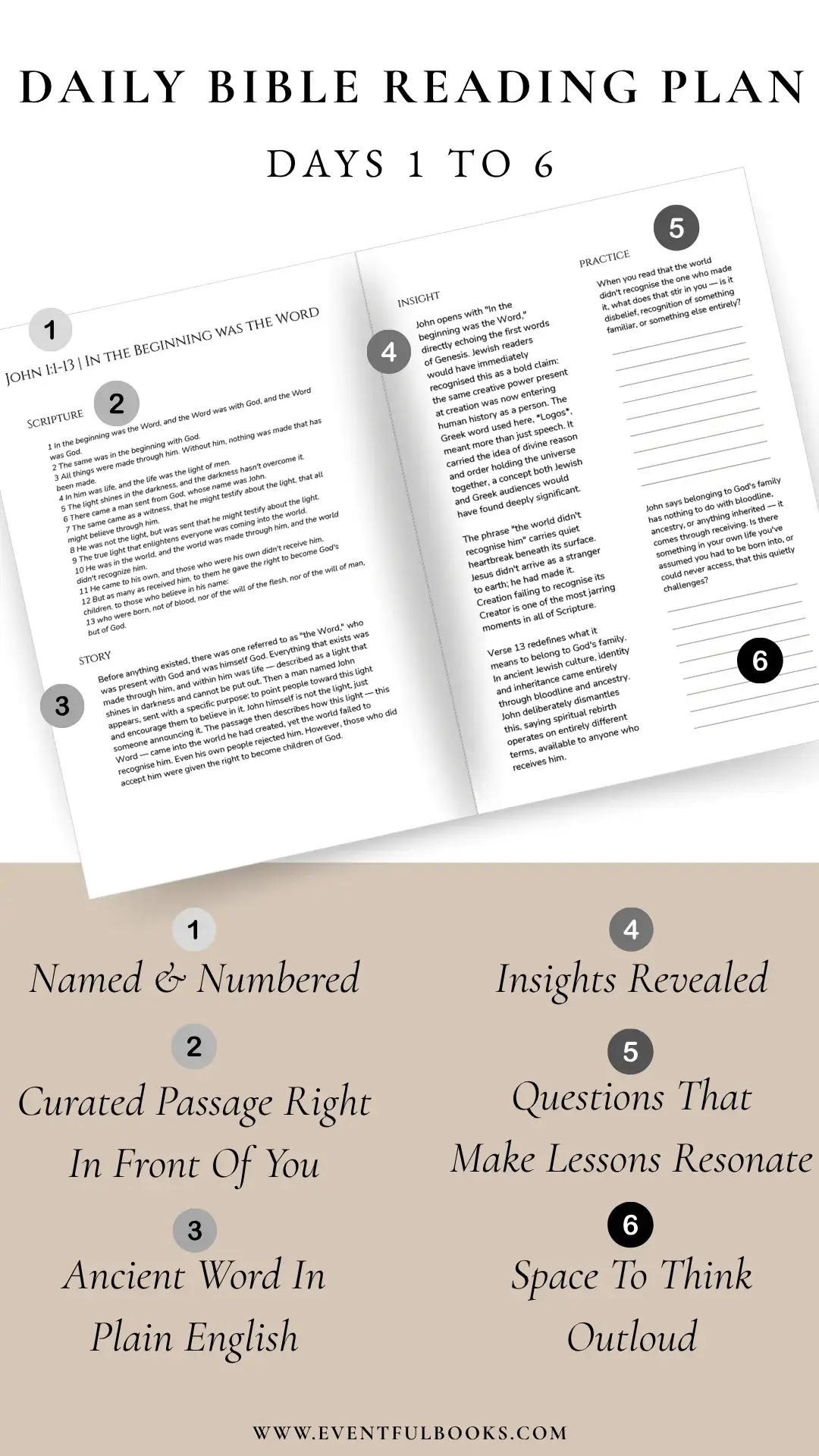
- Everything on one spread. Each day gives you the full Scripture text, plain-English context, and commentary-style insight together, so you’re not juggling a stack of separate Bible study resources.
- A rhythm you can’t fail. Six days of study plus a Sabbath reflection give a flexible structure for busy lives. Miss a day and simply pick up where you left off.
- Made for solo, beginner and group Bible studies. The reflection questions work just as well for personal journaling as for weekly group discussion.
What Each Daily Gospel of John Reading Plan Includes
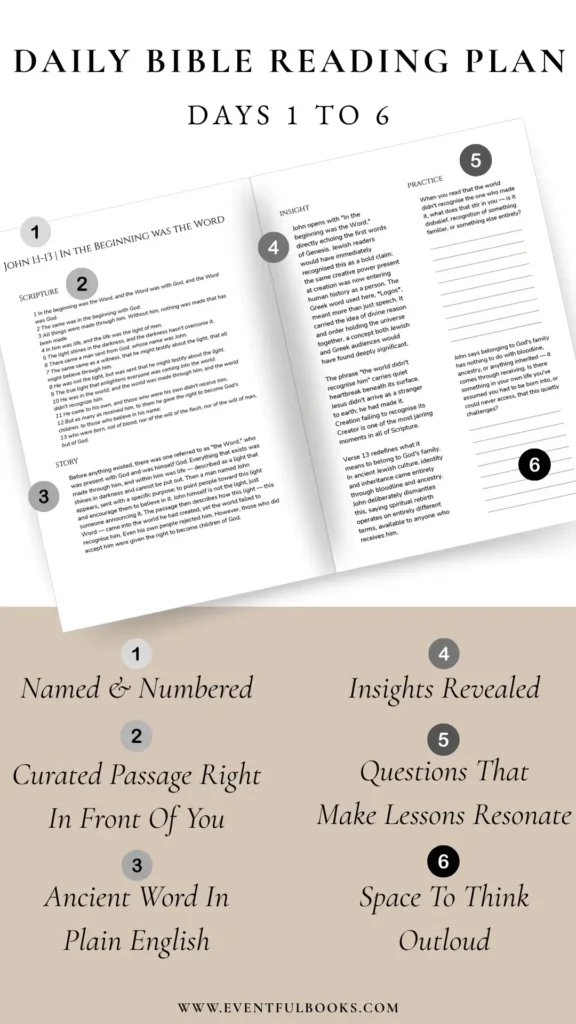
- The Passage: the day’s Scripture, printed in full from the World English Bible (WEB), so you don’t need a separate Bible open.
- In Plain English: a clear, jargon-free explanation of what’s happening in the passage and why it matters.
- Going Deeper: historical background, context, and spiritual insight for a deeper understanding of the text. It’s like having a short commentary right beside you.
- Reflect: honest questions for observation and reflection that help you connect the passage to your own life.
Sabbath Reflection: Step Into Jesus’ World
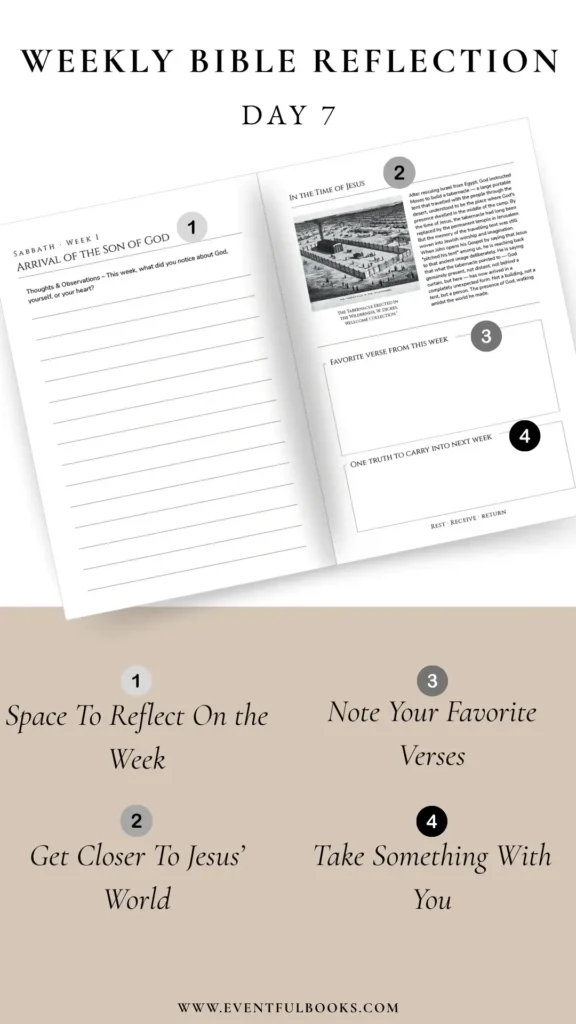
On the seventh day, the pace slows. Each Sabbath reflection gives you space to look back over the week and see the bigger picture:
- A full page for longer reflection on what you’ve read
- A look at the world Jesus lived in through artefacts and important sites from first-century Israel, from the streets of Jerusalem to the Temple courts where He taught
- A place to record your favourite verse from the week
- One thing to carry forward into the week ahead
Gospel of John Bible Study Guide – Daily Workbook and Interactive Bible Journal
You don’t need a theology degree or hours of free time to study God’s Word well. This Gospel of John Bible study guide meets you right where you are: one short passage a day, explained in plain English, with questions that help it take root in your life. Available in paperback, ebook and Kindle.
How to Do a Bible Study on the Book of John?
The easiest way to study the book of John is to take it one short passage at a time and work through four steps: read the text, observe what it says, interpret what it means, and apply it to your life. Begin each session with a short prayer, and aim for consistency over speed.
This simple, easy Bible study method works for personal study or for group Bible studies, and it’s the same rhythm this guide is built around.
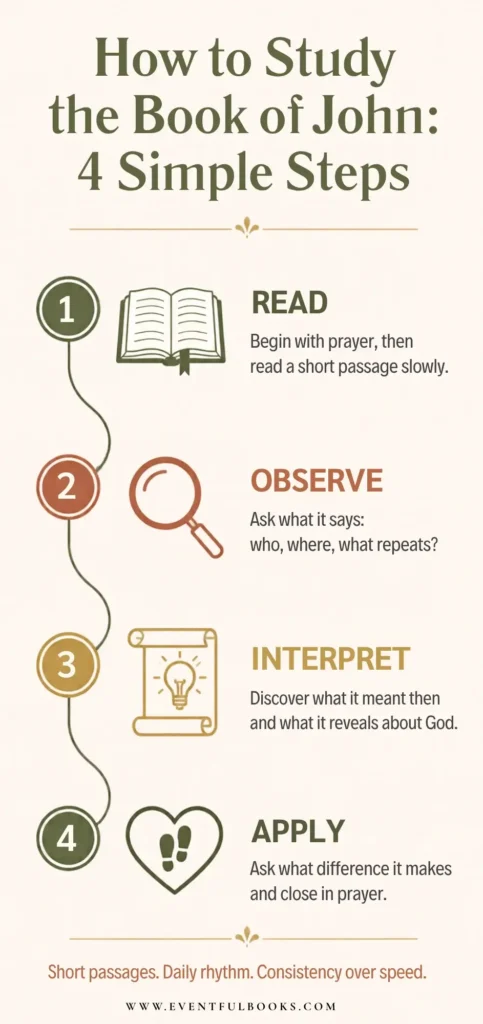
1. Read
Start with prayer, asking God to open your eyes to what He wants to show you. Then read the passage slowly, ideally more than once. John is best taken in small portions rather than a whole chapter at a time, so there’s room to notice what’s actually on the page.
In this guide: each day’s passage is printed in full, so you can open the workbook and begin.
2. Observe
Before asking what a passage means, ask what it says. Who is speaking? Where are they? What words or ideas repeat? What does Jesus do, and how do people respond? Careful observation is the foundation of good Scripture study.
In this guide: the observation questions help you notice details you might otherwise read straight past.
3. Interpret
Next, ask what the passage meant to its first readers and what it reveals about God. This is where context matters most: the history, the culture, and how the passage connects to the rest of John’s Gospel and the wider Bible.
In this guide: the Insigth sections explain the background and meaning, giving you a deeper understanding without needing a shelf of reference books.
4. Apply
Finally, ask what difference this makes. Is there a promise to trust, a truth to believe, or a change to make? Close your study by praying about what you’ve learned.
In this guide: honest reflection questions help you carry each passage into your everyday life, and the Sabbath reflection gives you space to look back over the week.
What are the Key Passages Covered in This Book of John Study Guide?
This guide works through the Gospel of John from beginning to end, so it covers every major passage in the book. Here are some of the best known.
John opens with a deliberate echo of Genesis 1: “In the beginning was the Word, and the Word was with God, and the Word was God” (John 1:1). The eternal Word existed before creation, was with God, and was God. This verse is central to the Christian understanding of the Trinity.
John 1:14 then describes the incarnation: “The Word became flesh, and lived among us… full of grace and truth.” In Jesus, the Word of God took on human life. John also contrasts the law given through Moses in the Old Testament with the grace and truth that came through Jesus Christ (John 1:17).
“For God so loved the world, that he gave his one and only Son, that whoever believes in him should not perish, but have eternal life.”
John 3:16 is often called the Gospel in a single sentence. It comes from Jesus’ night-time conversation with Nicodemus, a Pharisee and member of the Jewish ruling council. Jesus tells him that no one can see the kingdom of God without being born again. This new birth by the Spirit echoes John 1:12–13, where those who believe receive the right to become children of God. The verse sums up the heart of salvation: God’s love, the gift of His Son, and eternal life through faith.
John calls Jesus’ miracles “signs” because each one points to who He is. These miraculous signs serve as a witness to His identity. John states their purpose directly: they were written “that you may believe that Jesus is the Christ, the Son of God” (John 20:31).
| Sign | Passage |
|---|---|
| Turning water into wine at Cana | John 2:1–11 |
| Healing the royal official’s son | John 4:46–54 |
| Healing the man at the pool of Bethesda | John 5:1–15 |
| Feeding the 5,000 | John 6:1–14 |
| Walking on water | John 6:16–21 |
| Healing the man born blind | John 9:1–41 |
| Raising Lazarus from the dead | John 11:1–44 |
The raising of Lazarus is the climactic sign. It leads directly to the plot to kill Jesus.
Seven times in John, Jesus describes Himself with the phrase “I am.” It echoes God’s name revealed to Moses in Exodus 3:14 in the Old Testament, and points to Jesus’ divine nature.
| Statement | Passage |
|---|---|
| “I am the bread of life” | John 6:35 |
| “I am the light of the world” | John 8:12 |
| “I am the door” | John 10:9 |
| “I am the good shepherd” | John 10:11 |
| “I am the resurrection and the life” | John 11:25 |
| “I am the way, the truth, and the life” | John 14:6 |
| “I am the true vine” | John 15:1 |
These statements build on the theme of light and life introduced in John 1:4. The claim reaches its sharpest form in John 8:58: “Before Abraham came into existence, I AM.”
John’s Gospel gives Jesus a remarkable number of titles. Most of them appear in the first chapter.
| Title | Passage | Who uses it |
|---|---|---|
| The Word | John 1:1 | John, in his opening |
| Lamb of God | John 1:29 | John the Baptist |
| Messiah (Anointed One) | John 1:41 | Andrew |
| Son of God | John 1:49 | Nathanael |
| King of Israel | John 1:49 | Nathanael |
| Son of Man | John 1:51 | Jesus, of Himself |
| The Christ | John 20:31 | John, stating his purpose |
“Messiah” (Hebrew) and “Christ” (Greek) both mean “Anointed One.”
John 18–21 records Jesus’ arrest, His trial before Pilate, and His crucifixion. On the cross He says, “It is finished” (John 19:30).
Mary Magdalene is the first to see the risen Jesus at the empty tomb (John 20:11–18). He later appears to the disciples, including the doubting Thomas. The Gospel closes by the Sea of Galilee, where Jesus restores Peter, who had denied Him three times. Three times Jesus asks him, “Do you love me?” and gives the charge “Feed my sheep” (John 21:15–17). It’s a lasting picture of forgiveness and of discipleship.
Gospel of John Bible Study Guide – Daily Workbook and Interactive Bible Journal
Mark it up, write in the margins, and keep it on your shelf for years to come. The Gospel of John Bible study guide is available in paperback and hardback on Amazon.

What Is the Gospel of John?
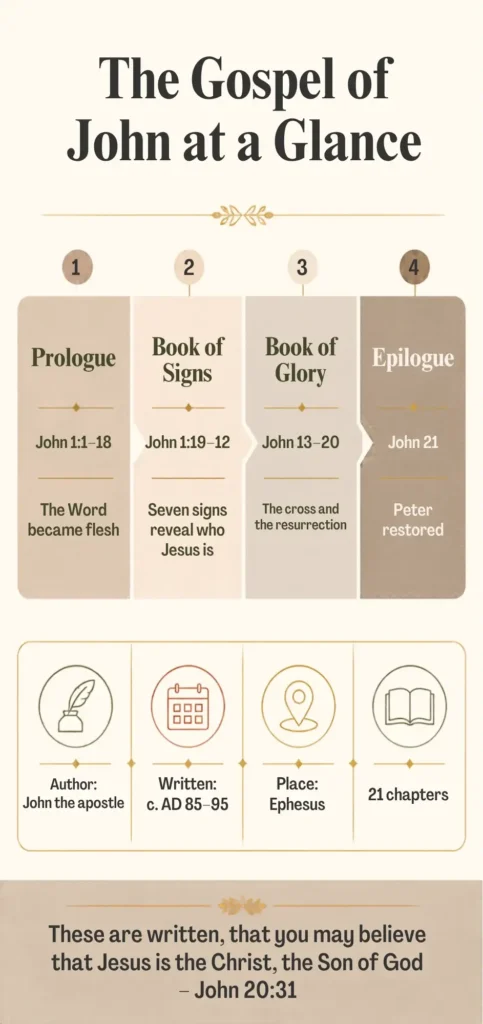
The Gospel of John is the fourth of the four Gospels in the New Testament. It tells the story of Jesus’ life, death, and resurrection. Its 21 chapters fall into four main parts:
- The Prologue (1:1–18): an introduction presenting Jesus as the eternal Word of God made flesh.
- The Book of Signs (1:19–12:50): Jesus’ public ministry, built around seven miraculous signs and His teaching.
- The Book of Glory (13–20): the Last Supper, Jesus’ farewell teaching to His disciples, His crucifixion, and His resurrection.
- The Epilogue (21): the risen Jesus by the Sea of Galilee and the restoration of Peter.
The main points of the Gospel of John are who Jesus is, why He came, and what it means to believe in Him.
Who Wrote the Gospel of John and When?
The Gospel never names its author. It identifies him as “the disciple whom Jesus loved” (John 21:20–24), an eyewitness who was close to Jesus. Early church tradition identifies him as John, son of Zebedee, one of the twelve apostles and the brother of James.
According to the second-century writer Irenaeus, John wrote his Gospel while living in Ephesus, a major city in what is now western Turkey. Most scholars date it to around AD 85–95, making it probably the last of the four Gospels to be written.
What Is the Purpose of John’s Gospel?
John’s purpose is stated plainly near the end of the book: “these are written, that you may believe that Jesus is the Christ, the Son of God, and that believing you may have life in his name” (John 20:31).
The whole Gospel is built as a witness to that truth. John the Baptist, the signs, Jesus’ own words, and finally the disciples all testify to who Jesus is. The aim is salvation: that readers would come to faith and receive eternal life.
What Are the Main Themes of John’s Gospel?
- The Word (Logos): Jesus is the eternal Word, present at creation and fully God (1:1).
- Light and life: Jesus brings light into a dark world and gives life to all who come to Him (1:4–5, 8:12).
- Grace and truth: Both came fully through Jesus Christ (1:17). “You will know the truth, and the truth will make you free” (8:32).
- New birth: Entering God’s kingdom requires being born again by the Spirit (3:3–8). Those who believe become children of God (1:12).
- Eternal life: For John, eternal life is more than endless life. It begins now, in knowing God (17:3).
- Love one another: Jesus gives a new commandment: “Just as I have loved you, you also love one another” (13:34). He links love for Him with keeping His commandments (14:15).
- The Holy Spirit: Jesus promises the Spirit as Counselor and teacher, along with His peace (14:16–27).
- Father, Son, and Spirit: John’s account of the relationship between Father, Son, and Spirit has shaped Christian teaching on the Trinity. It’s a large part of why John is known for its theological depth.
How Is John Different from the Synoptic Gospels?
The Book of John concentrates on who Jesus is, while the Synoptic Gospels; Matthew, Mark, and Luke mainly tell the story of what Jesus did and taught.
The books of Matthew, Mark, Luke are called the Synoptic Gospels, from the Greek for “seen together,” because they share much of the same material and order. Most of John’s content, however appears only in John. Some of the key differences between the Gospel of John and the other Synoptic Gospels includes:
- No story parables or exorcisms. In place of short parables, Jesus gives long discourses and extended conversations.
- A Jerusalem focus. Much of the action takes place in Jerusalem and Judea, often around the Temple during major Jewish feasts.
- A longer timeline. John mentions at least three Passovers, which is where the idea of a roughly three-year ministry comes from.
- Unique events. The wedding at Cana, the raising of Lazarus, and Jesus washing the disciples’ feet appear only in John. There is no birth narrative.
- Theological depth. John reflects more directly on who Jesus is, which is why it’s often called the most theological of the four Gospels.
Who Are the Key People in the Gospel of John?
Some of the key people that appear in the Gospel of John include:
- John the Baptist: the forerunner who points to Jesus as “the Lamb of God” (1:29).
- Peter: a leading disciple who denies Jesus three times and is restored after the resurrection (21:15–17).
- Nathanael: appears only in John. He is called “an Israelite in whom is no deceit” and declares Jesus the Son of God (1:47–49).
- Nicodemus: a Pharisee who visits Jesus at night (ch. 3) and later helps bury Him (19:39).
- The Samaritan woman: meets Jesus at Jacob’s well and brings her town to hear Him (ch. 4).
- Lazarus: brother of Mary and Martha of Bethany, raised from the dead by Jesus (ch. 11).
- Mary Magdalene: the first person to see the risen Jesus (20:11–18).
- Thomas: the disciple who doubts the resurrection, then confesses, “My Lord and my God!” (20:28).
Frequently Asked Questions
Is the Gospel of John a good place to start reading the Bible?
Yes. John is one of the most commonly recommended starting points for new readers. It’s written so that readers “may believe that Jesus is the Christ” (John 20:31), it introduces who Jesus is from the very first chapter, and it doesn’t assume prior knowledge of the rest of the Bible.
Is John the Baptist the same John who wrote the Gospel of John?
No. John the Baptist was Jesus’ relative and forerunner, who was beheaded by Herod Antipas before Jesus’ death. The Gospel is traditionally attributed to John the apostle, son of Zebedee, one of the twelve disciples. According to church tradition, he lived to old age in Ephesus.
Did the same John write 1, 2, and 3 John and Revelation?
Church tradition attributes all five books to John the apostle. The letters of 1, 2, and 3 John share the Gospel’s vocabulary and themes, such as love, light, truth, and eternal life, so most readers see a close connection. Revelation’s authorship is more debated among scholars.
Does the Gospel of John include the birth of Jesus?
No. Unlike Matthew and Luke, John has no Christmas story. Instead of beginning at Bethlehem, it begins before creation: “In the beginning was the Word” (John 1:1). Jesus’ arrival is described as the Word becoming flesh (John 1:14).
Is this study guide tied to a particular denomination?
No. The guide focuses on what the text of John says and means, and it’s suitable for readers from any Christian tradition.
Related products
- 180 Bible Verses For Encouragement: Scripture For Hard Days and Hopeful Hearts to Pinterest (opens in a new window)

- Grandma’s Memoirs — A Guided Life Story Journal: Keepsake for Grandmothers to Share Their Life Stories to Pinterest (opens in a new window)
- Dad’s Memoirs — A Guided Life Story Journal: Keepsake for Fathers to Share Their Life Stories to Pinterest (opens in a new window)



Reviews
There are no reviews yet.