How to Read the Bible for Beginners: A Simple Step-by-Step Guide
If you’ve ever searched how to read the Bible for beginners and closed the tab feeling more overwhelmed than when you opened it, you’re not alone.
Somewhere in your house right now, there’s probably a Bible — on your nightstand with a thin layer of dust, a gift from your grandmother, or something you bought during a season when you promised yourself this would be the year you finally read the entire Bible.
Maybe you got three chapters into Genesis, hit a wall of names you couldn’t pronounce, and quietly closed it, telling yourself you’d pick it back up later.
If that’s you, take a breath. You are not behind, and you are not doing this wrong. You’re just getting started — and getting started is the only step that matters today.
The Bible wasn’t written to be read like a novel, front to back, in one tidy sweep. It’s not a single Bible story about Jesus Christ — it’s a library, sixty-six books written across centuries, in different styles, for different reasons.
So if you’ve felt intimidated not knowing where to begin, that’s not a you problem. That’s just what happens when you hand anyone a library and no map.
You don’t need a theology degree or a church upbringing to start reading Gods word today. You just need somewhere to open it — and by the end of this post, you’ll know exactly where that is.
Remember! There is no wrong way to start your Bible reading journey!
Maybe you’re coming back to faith after years away. Maybe you’re brand new to all of this, praying without really knowing how.
Either way, you’re allowed to start exactly where you are — there’s no prize for reading it the “right” way, and no version of this where you’re already too far behind.
Everyone who seems to have their bible reading figured out started exactly like you’re about to: small, unsure, and a little bit hopeful.
So let’s make this simple. Below are nine steps that will take you from “I don’t even know where to open it” to actually reading, understanding, and responding to Scripture — in a way that fits into the real, busy life you’re already living.
Step 1: Choose an Easy-to-Read Bible Translation Before You Begin
Before you read a single verse, you’ll need to pick a translation — and this trips up more beginners than almost anything else.
The Bible was originally written in Hebrew, Aramaic, and Greek, so every English Bible is a translation, and different translations make different choices about how closely to stick to the original wording versus how readable they are in modern English.
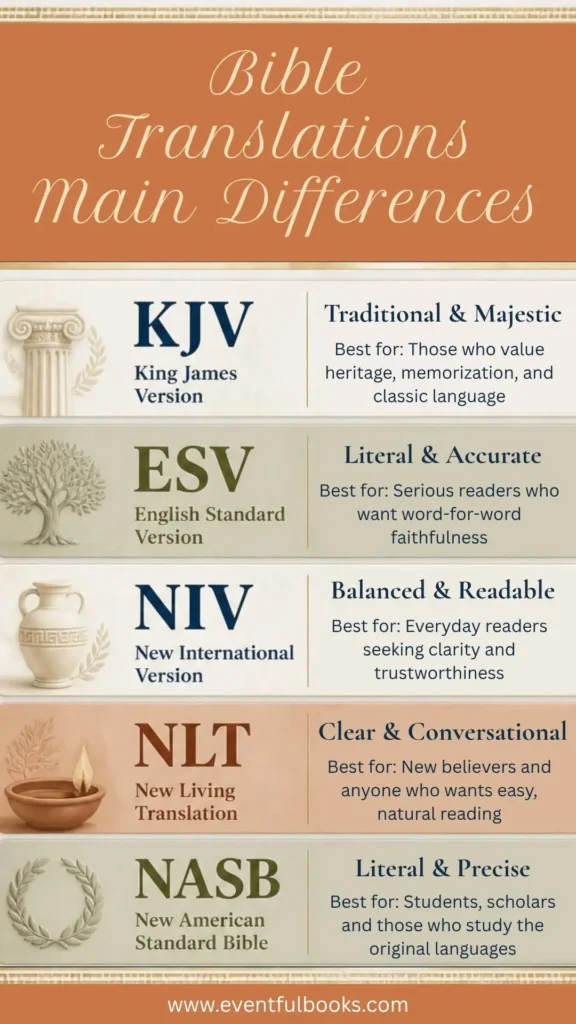
For a beginner, a “thought-for-thought” or readable bible translation is usually the better starting point. To find a translation that’s right for your needs check out our guide on understanding bible translations. A few good options:
- NIV (New International Version) — clear, widely used, a great all-around choice
- NLT (New Living Translation) — reads almost like modern conversation, very approachable
- ESV (English Standard Version) — slightly more traditional in wording, still very readable
- CSB (Christian Standard Bible) — a solid modern middle ground between accuracy and readability
- NASB (New American Standard Bible) — more literal, worth exploring once you’re ready for deeper study
You may have grown up with an ESV study Bible, the King James Version (KJV) or another Protestant Bible passed down in your family — nothing wrong with it, but 17th-century English (“thee,” “thou,” “wherefore”) can make an unfamiliar book feel even harder to follow as a beginner.
If that’s the only bible version you own, no need to buy a new one — free tools like Bible Gateway and the YouVersion Bible app let you read almost any translation instantly, right from your phone.
There’s no single “correct” translation, holy as they all are — this is about picking the one you’ll actually understand and want to keep reading. Don’t overthink this step; pick one that reads easily, and move on.
Step 2: Skip Genesis and Start With One of the Gospels Instead
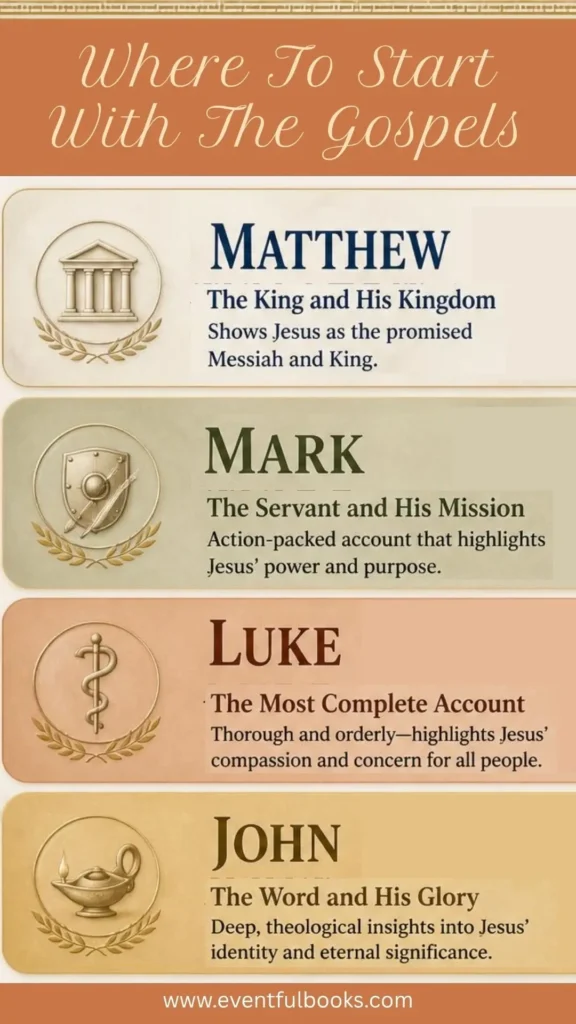
It’s tempting to start at Genesis 1:1 and work through in order — but for a beginner, that’s one of the fastest ways to stall out. A few chapters into the Old Testament, you’ll hit long genealogies and unfamiliar names, and it’s easy to feel like you’ve already failed before you’ve really started.
Instead, start in the New Testament, with one of the four Gospels — Matthew, Mark, Luke, or John — which tell the story of Jesus life, death, and resurrection. These are the most natural entry point into the Bible because they’re written as narrative, they center on Christ Jesus himself, and they help you understand who the rest of Scripture actually points toward.
Here’s something that trips people up: Matthew, Mark, and Luke cover a lot of the same events, told from slightly different angles for different original audiences. So if you’re wondering which one to read, the honest answer is you can’t go wrong picking just one.
For the most complete single account of Jesus’s life, Luke is a great choice — it’s the longest of the four, and Luke opens by explaining he carefully investigated everything to write a thorough, orderly account (Luke 1:1–4).
John, the fourth Gospel, is more reflective and personal, focusing less on retelling every event and more on who Jesus Christ said he was — a wonderful, shorter, more intimate starting point, though it won’t cover quite the same ground as Luke.
Once you’ve read a Gospel, the letters of the Apostle Paul are a natural next step, unpacking what Jesus life and resurrection actually mean for how you live. But for now, pick one Gospel, and don’t worry about “getting it right.” You can always read the others later.
Step 3: Try to Understand What’s Happening in Plain English
As you read, you’re going to run into things that don’t immediately make sense — true no matter how long you’ve been a Christian, not just as a beginner.
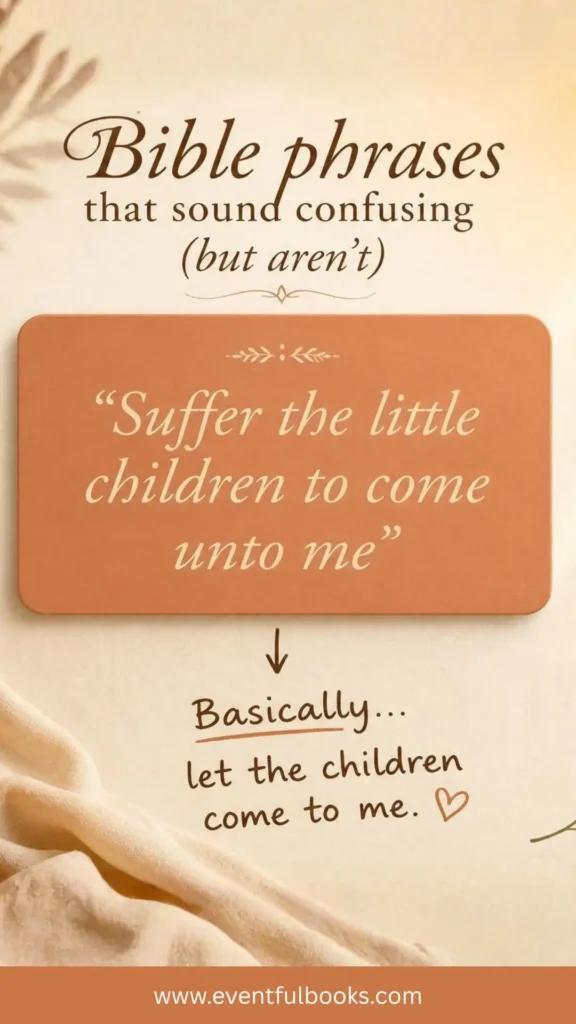
Maybe it’s a word you’ve never heard before, like being told to “suffer the little children to come unto me,” which sounds painful until you learn “suffer” simply meant “allow” in 17th-century English.
Maybe it’s a custom that feels foreign, like why someone would wash another person’s feet, or what it meant to be called a “tax collector.”
Or maybe you understand every sentence individually but still aren’t sure what’s actually happening in the bigger picture.
All of that is normal. Nobody instantly understands every reference or turn of phrase in a bible passage — this is a book written thousands of years ago, in cultures very different from ours, so a little friction is expected.
When you hit one of these moments, pause and get curious instead of pushing past it confused:
- Use the free dictionary or notes feature on Bible Gateway or Blue Letter Bible to look up a specific word
- Search “what does [phrase] mean in the Bible” for a short, clear explanation
- Reread the sentence or two around the confusing part slowly, in plain English, and ask: what is actually happening here, to these people?
- If a whole passage feels unclear, look up a simple summary of that chapter to get the bigger picture first
You don’t need to fully understand every bible verse before moving on. Clarity often comes days or weeks later, in a different passage entirely. Give yourself permission to keep reading with a few question marks still hanging in the air.
Step 4: Try to Understand One or Two Insights That Aren’t Obvious to a Modern Reader
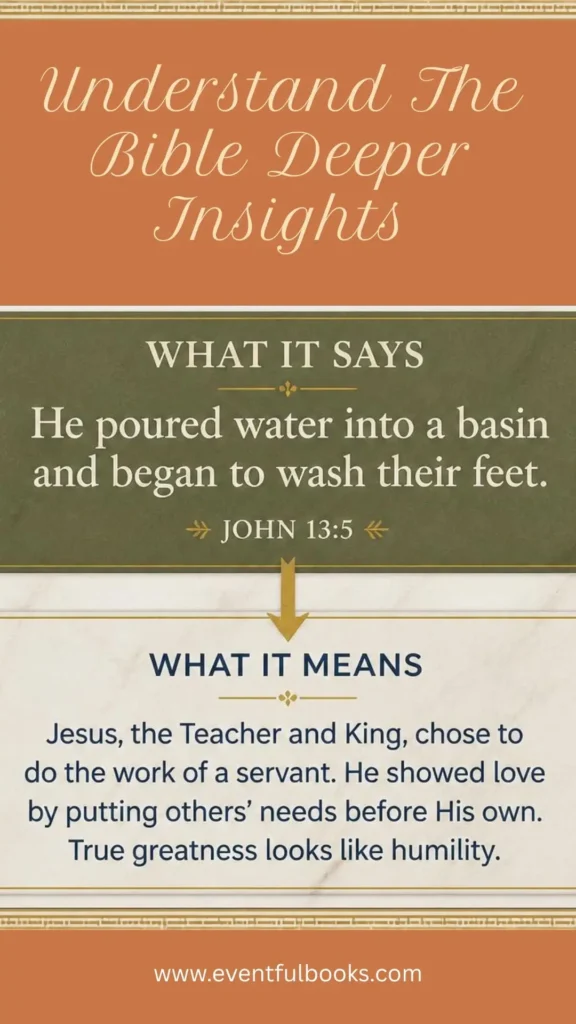
Some parts of the Bible read plainly on the surface but carry meaning underneath that a modern reader would never guess — because the original audience already knew things we don’t.
When Jesus tells the story of a Samaritan helping an injured man (the “Good Samaritan”), it’s easy to read as a simple story about kindness.
But Samaritans and Jews despised each other in that culture, so Jesus was making a sharper point: the person you’d least expect might show more love than the people you’d assume would help.
That detail changes the whole weight of the story — a piece of practical wisdom hidden just beneath the surface.
Or take something as small as a number. Forty shows up again and again in Scripture — forty days of rain in Noah’s story, forty years in the wilderness, forty days Jesus Christ fasted in the desert.
To the early church and its Jewish roots, forty represented a period of testing or preparation, not just a count of days. Once you know that, passages that seemed like coincidence start to feel intentional.
You don’t need to become a Bible historian for this deeper understanding — just stay curious.
As you read, ask: is there something here a first-century reader would have understood instantly that I might be missing? Sometimes the answer is no.
But every so often, digging one layer deeper turns an ordinary passage into something that stops you in your tracks and reveals a little more of Gods character.
A simple habit that helps: whenever a detail feels oddly specific — a number, a location, a custom — do a quick search on it. More often than not, a small piece of historical context is waiting there, ready to make the passage click.
Step 5: Respond to What You Read — Then Write It Down
Here’s something most beginners don’t realize: reading the Bible and actually growing from it are two different things — and the gap between them is response.
It’s entirely possible to read a whole chapter and walk away with almost nothing, not because the passage wasn’t meaningful, but because you never paused to let it land.
Scripture wasn’t written to be information you collect — it’s meant to be engaged with, the way you’d engage with a letter from someone who loves you. That shift changes how God’s word sits with you afterward.
This is also where real spiritual growth quietly happens through daily prayer and reflection, guided gently by the Holy Spirit.
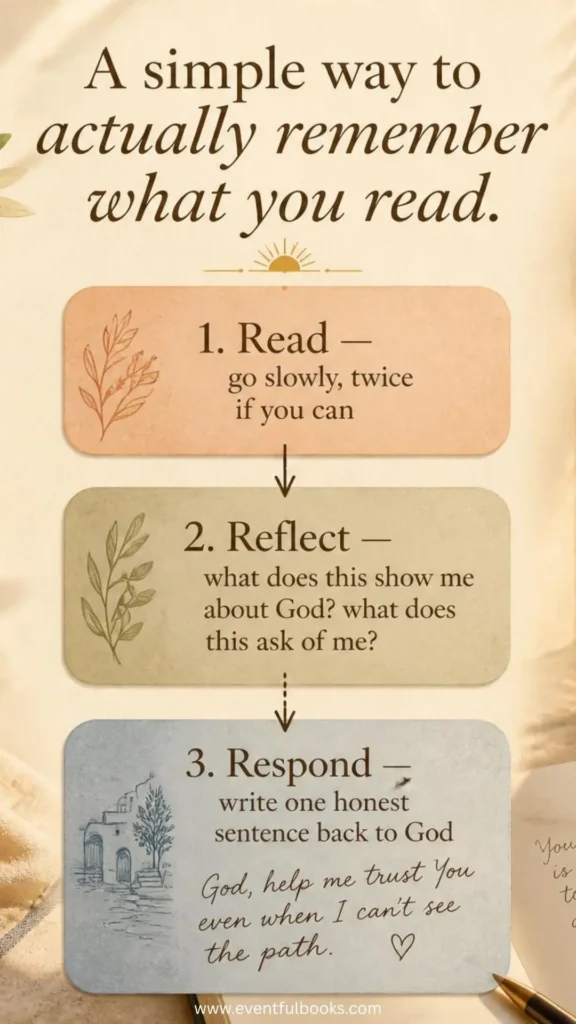
It’s rarely the reading itself that changes you — it’s the moment after, when you let it ask something of you: What does this show me about God? What is it asking me to believe or do differently?
A simple three-step method works for anything you read:
- Read. Go through the passage slowly — twice, if you can.
- Reflect. Ask: What does this tell me about God? What does this ask of me?
- Respond. Write or pray one honest sentence back to Him — “God, help me trust You even when I can’t see the whole path” is a complete, real response.
Then, don’t let that response disappear the moment you close your Bible. Writing it down — even a little bible journaling, one line in a notes app or the margin of your Bible — is what actually makes it stick.
A bible passage you jotted three words about six months ago can mean something completely different when you reread it in a new season; growth you might have missed becomes visible, and questions that once had no answer will sometimes have quietly resolved themselves.
Read, Reflect, Respond, Record — four simple moves, and a method you can use for the rest of your life, in any book of the Bible, in any season.
Step 6: Know What to Do When the Bible Feels Confusing or You Feel Nothing
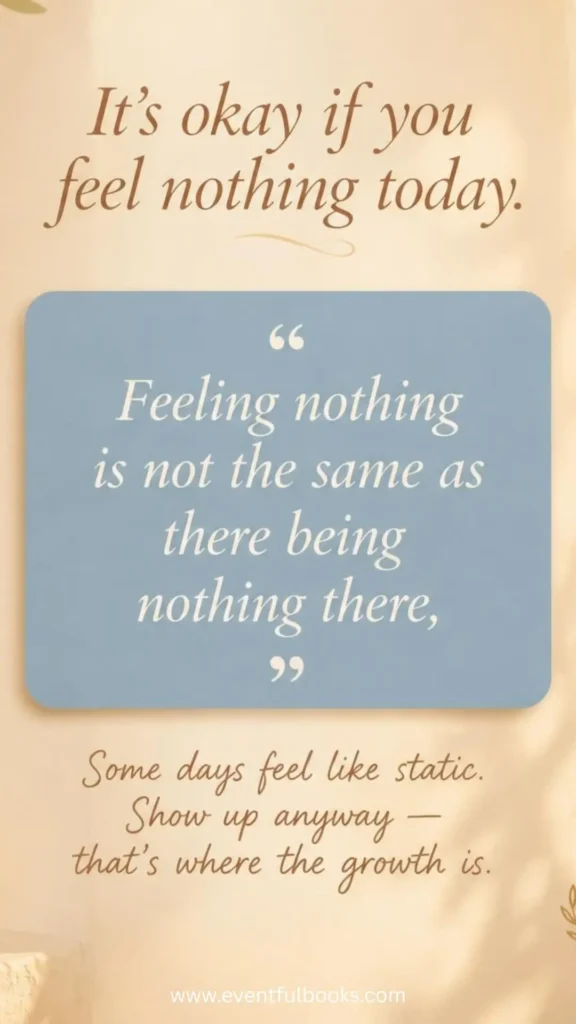
At some point, you’re going to sit down, read a passage, and feel completely flat. No lightbulb moment, no sense of peace, maybe not even full understanding. If you’re like most beginners, your first thought will be: something is wrong with me.
It isn’t. This happens to everyone — new believers and pastors alike. Faith isn’t a straight line of constant clarity; it has seasons.
Some days Scripture feels alive in your hands, other days it feels like a phone book. Neither means you’re doing it wrong, and neither means God has gone quiet.
Feeling nothing is not the same as there being nothing there — Gods love doesn’t depend on how much you feel in a given moment.
So what do you actually do, instead of quietly giving up?
- Keep reading anyway, even without the feeling. Don’t wait for a spiritual high before the time counts as “worth it.” Showing up consistently is what builds a habit — understanding often catches up weeks later, in a passage that suddenly makes an earlier one click.
- Say it honestly, out loud or on paper. If you’re confused, tell God so. “God, I don’t understand what I just read, and I don’t feel close to You right now” is a completely legitimate prayer — you’re not required to perform peace you don’t have.
- Shrink the passage, not your effort. If a whole chapter felt like static, try just one verse next time.
- Ask a real question and go looking for the answer. Write it down, search it, or bring it to a friend or bible study group. Confusion you chase down becomes understanding; confusion you avoid just becomes a reason to quit.
- Remember this is a relationship, not a performance review. You wouldn’t call a friendship “failing” over one flat conversation. Give your relationship with God, rooted in genuine faith, that same grace.
The goal was never to feel something every time you open your Bible. The goal is to keep showing up — and the confusing, flat, uncertain days are often where the deepest growth actually happens.
Step 7: Start With a Reading Plan You Can Actually Keep
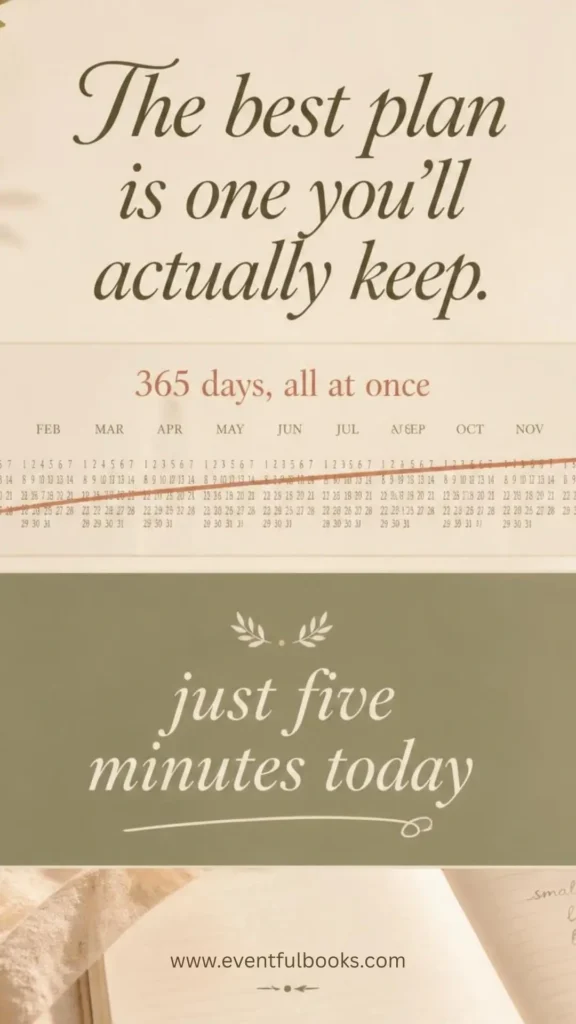
Most people don’t quit reading the Bible because they lost interest. They quit because their bible reading plan was never realistic to begin with.
A year-long, read-the-entire-bible-in-365-days chart looks inspiring on day one — and by day twelve, when life gets busy and you miss a few days, it starts to feel like a scoreboard you’re already losing. So you close it, tell yourself you’ll “restart properly” later, and later never quite comes.
The fix isn’t more willpower. It’s a smaller plan.
Start absurdly small — smaller than feels impressive. Five minutes. One short passage, using the Read, Reflect, Respond method from Step 5.
The goal in these early weeks isn’t depth or coverage — it’s proving to yourself this is something you can actually keep doing, not just something you meant to do.
A few ways to make a plan realistically “keepable”:
- Attach it to something you already do. Read while your coffee brews, or during your kid’s nap. A new bible reading habit sticks far better next to an existing one than floating alone in an already-full day.
- Pick a number of days, not a finish line. Instead of “I’ll finish the Gospel of Luke,” try “I’ll open my Bible five days this week.” A finish line invites guilt when it slips; a frequency goal is forgiving and easy to pick back up.
- Let missed days be just that. If you skip a day or a week, you haven’t broken anything — there’s no streak to protect, and no shame in restarting for the hundredth time.
- Expect to outgrow this plan — that’s the goal. A five-minute habit that sticks for months will take you further than an ambitious one that collapses in three weeks. Once it feels easy and automatic, you’ll naturally want more.
Small and sustainable will always outperform big and abandoned. Give yourself the plan you can actually keep. However, if you feel more confident and determined then you can download our free Bible Chapter Tracker and print it to keep it with you on your journey.
Step 8: Try Different Ways of Reading the Bible Until One Fits
People learn and retain differently, and the same is true for how we connect with Gods word. Some process best writing things out slowly, word by word. Others need Scripture spoken aloud while they drive or do dishes — a good moment for an audio bible.
Some do best with a study bible or guided structure that tells them exactly what to read and reflect on each day, rather than staring at a blank page. None of these is more “spiritual” than another — just different doors into the same room.
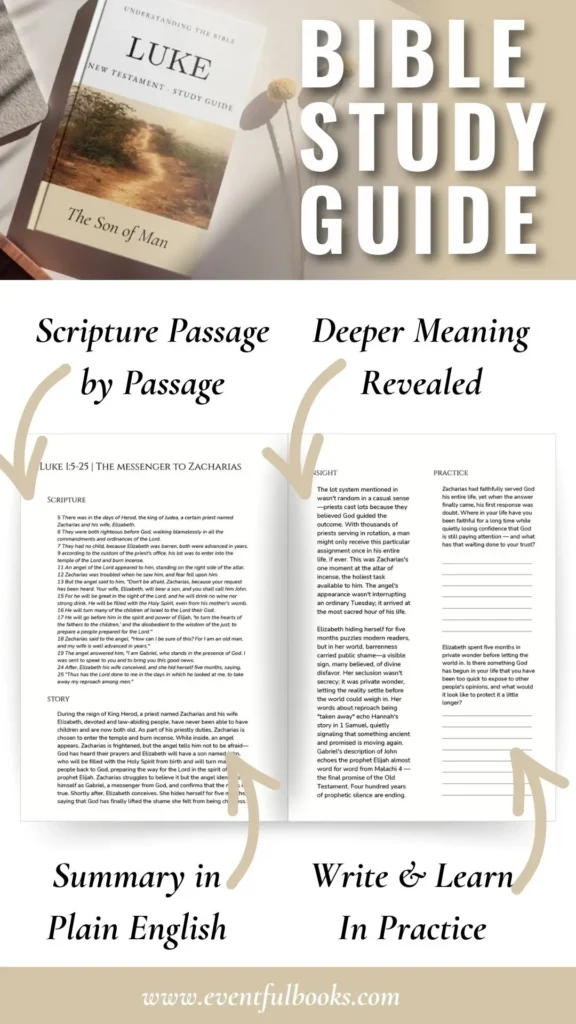
If you’d like some of this structure already built for you, that’s exactly why we created our own series of Bible study guides — each one breaking a chapter into a short passage, a plain-English explanation, a few insights you might otherwise miss, and two simple reflection questions to help it stick.
We also have devotional word search and crossword books, pairing a short daily reading and prayer with a gentle, screen-free puzzle for the days you want to sit with Scripture in a slower, more tactile way.
There’s no wrong way to do this, and no rule that says you have to pick one method forever. Try a few. Notice which one makes you actually want to come back the next day — that’s usually a sign you’ve found the right fit for this season. And if it stops fitting later, that’s fine too. You’re allowed to keep adjusting for the rest of your life.
Final Words
Something feels different lately, doesn’t it? The headlines don’t let up. It’s easier than ever to lose an hour to a doom scroll and come away more unsettled than when you started, quietly wondering if anything is actually steady anymore. If you are.
We don’t think that feeling is random. Long before any of this, there was a place people turned when the world felt loud and hard to make sense of — not because it promised an easy fix, but because it had already outlasted every version of chaos that came before. Real christian faith was built to hold.
That’s what we hope this corner of the internet can be for you — somewhere quieter to land. If you’d like more of that, join our newsletter for early news on new releases, discounts, a bible verse worth sitting with, and gift ideas for the people in your life who might need a little steadiness too. Just a small, gentle reminder that you’re not carrying any of this alone.
No, there isn’t a single correct order. The Bible is not written as one continuous chronological narrative — it’s a collection of 66 books written across centuries in different styles (history, poetry, prophecy, letters), and its traditional page order groups books by type and testament, not by the order they happened or were written.
There’s no biblical mandate for reading front to back, and plenty of well-known reading plans (chronological, thematic, “Bible in a year”) intentionally reorder the books for different purposes.
Yes. Translations like the NLT (New Living Translation) and NIV (New International Version) are widely considered the easiest for modern readers, since they prioritize clear, natural, contemporary English over strict word-for-word accuracy.
If you want extra support beyond the translation itself, a guided study resource — like our Understanding The Bible guides, which break each passage down into plain-English explanations and simple reflection questions — can make even a more literal translation feel easier.
The NIV is generally easier to read than the ESV. The NIV translates meaning phrase-by-phrase into natural modern English, while the ESV uses a more “word-for-word” approach that stays closer to the original Hebrew and Greek sentence structure — which can occasionally result in more formal, complex phrasing. That said, the difference isn’t extreme.
Reading the entire Bible at a normal pace takes most people roughly 70-80 hours total, which breaks down to about 15-20 minutes a day over the course of a year, following a standard “Bible in a year” plan.
There’s no required timeframe, though — some people take multiple years reading slowly with reflection, while others complete it in a few intensive weeks. For a beginner specifically, there’s no benefit to rushing; a slower pace that prioritizes actually understanding and responding to what’s read is generally more valuable than speed.