What Are Bible Translations? How to Choose the Best Bible Translation for You
Ever picked up a Bible and wondered why it sounds a little different from the one your friend reads, or the one you grew up with at church?
You’re not alone — and it’s actually one of the most common questions people have once they start digging deeper into their faith.
So, what are Bible translations, really? At the simplest level, a Bible translation is the result of scholars taking the original words of Scripture and carefully turning them into a language we can actually read and understand today.
Because we’re working across such a huge gap in time and language, there isn’t just one single Bible version — there are dozens, each shaped by different goals, different eras, and different teams of translators doing their best to help us encounter the story of Jesus Christ and the truth of Gods Word as clearly as possible.
If you’ve ever felt a little lost trying to pick the “right” English Bible translation, or you’re just getting started with Bible study and want to understand what all the different names and abbreviations actually mean, you’re in exactly the right place.
In this post, we’re breaking down where these translations came from, what makes them different from one another, and how to find the one that feels like it was made just for you. Let’s dive in.
What Is a Bible Translation, Exactly?
The Bible was written thousands of years ago in languages most of us will never read fluently.
So every single English Bible on the shelf — whether it’s the one your grandma gave you or the one you just added to your cart — is the work of scholars and translators who took the original words and carefully turned them into language we can actually understand and live by.
But here’s the part that surprises people: not all Bible translations are made the same way.
Each one follows a different translation philosophy — basically, a set of rules the translators agreed on for how closely to stick to the original wording versus how much to prioritize making it read naturally in English.
That’s why the same verse can sound noticeably different depending on which Bible you pick up.
So when someone asks “what’s the difference between all these Bibles?” — this is really the heart of it. It’s not that one is “more true” than another (in most cases).
It’s that each bible translation made intentional choices about how to carry ancient words into modern hands, without losing what they were actually trying to say.
And once you understand that, choosing a Bible stops feeling overwhelming and starts feeling like finding the right voice for you.
Why Isn’t There Just One Bible? (Why Do We Need Translations at All?)
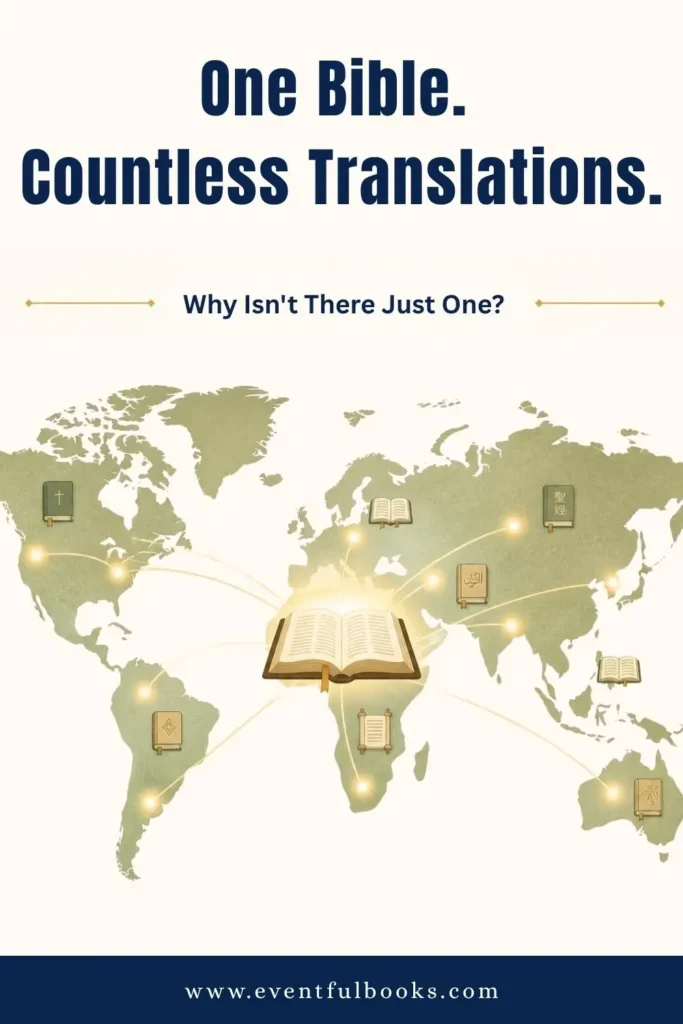
There actually is one Bible, in the sense that every translation is working from the same original texts.
What’s different is the journey each one took to get from those ancient pages into your hands. Think of it a bit like sheet music.
The notes on the page are the same, but hand that music to ten different musicians and you’ll get ten performances that each sound a little different — not because the song changed, but because of the instruments, the interpretation, the audience they had in mind.
That’s really why we ended up with so many options. Each English translation was built with a specific reader in mind.
Over centuries, different teams of scholars set out to bring Scripture to different groups of readers — some translating for churches doing formal readings out loud, some for everyday people who just wanted to sit down and read their Bible like a book, some for scholars who wanted every possible nuance preserved.
What Language Was the Bible Originally Written In?
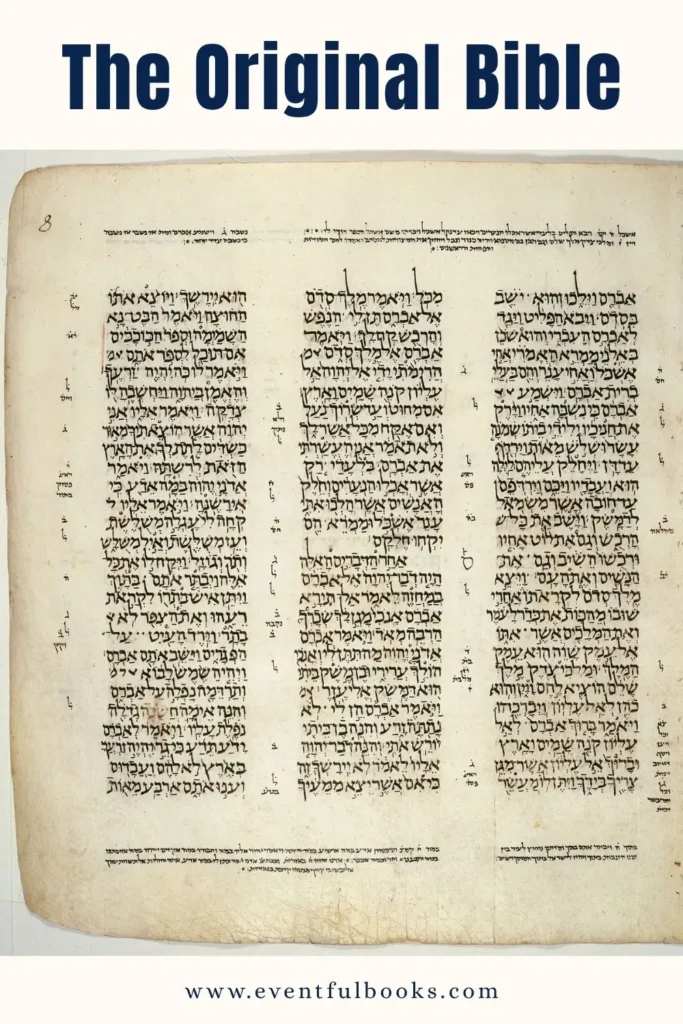
Needless to say, the English bible didn’t start out in English at all.
The old testament — the first, larger section of the Bible — was originally written almost entirely in Hebrew, with just a few short portions in Aramaic (a related language that was common in parts of the ancient Near East).
Together, these make up what scholars often call the hebrew bible, and it covers everything from Genesis all the way through the Prophets.
The new testament, on the other hand, was written in Greek — specifically, a widely spoken, everyday form of Greek called Koine Greek, which was basically the “common language” of the Roman world at the time, kind of like how English functions today.
That’s why you’ll often hear people refer to the Greek New Testament when they’re talking about the earliest known manuscripts of Matthew, John, Paul’s letters, and everything else in that section.
So when translators sit down to create a new English Bible, they’re not starting from some medieval English draft — they’re going all the way back to those Hebrew and Greek manuscripts, working directly from the original language the text was first written in, to make sure nothing gets lost along the way.
What Are the Different Types of Bible Translations?
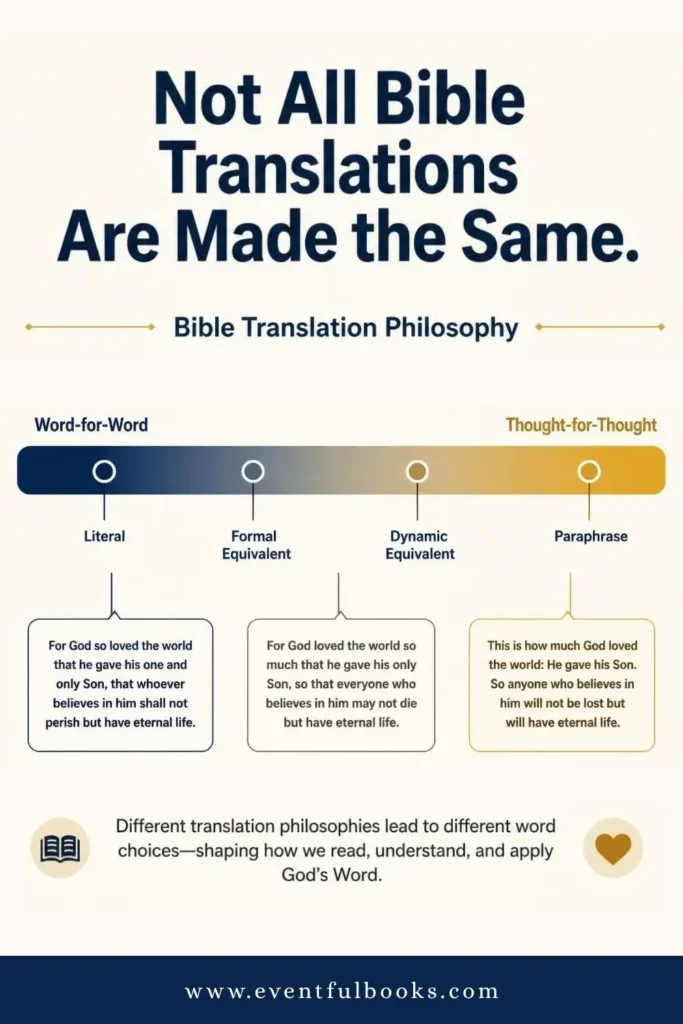
Every translator is working from the same original Hebrew and Greek texts, why do the words on the page still end up looking so different from Bible to Bible?
The answer comes down to a choice every translation team has to make before they even begin: how do you carry a word, a phrase, an entire sentence from one language into another, while keeping it both accurate and readable?
There’s no single “right” way to do it — which is actually why we’ve ended up with such a rich variety of options. Some modern translations lean toward staying as close as possible to the exact structure and wording of the original text, almost word by word.
Others focus more on capturing the full meaning of a passage, even if that means rearranging things so it reads more naturally in English. And a few go even further, aiming to make Scripture feel like a conversation you could have with a friend.
None of these approaches are trying to “change” the Bible — they’re just different lenses for bringing the same truth into focus. And once you understand the three main types, choosing between them gets a whole lot easier.
What Does “Word-for-Word” Bible Translation Mean?
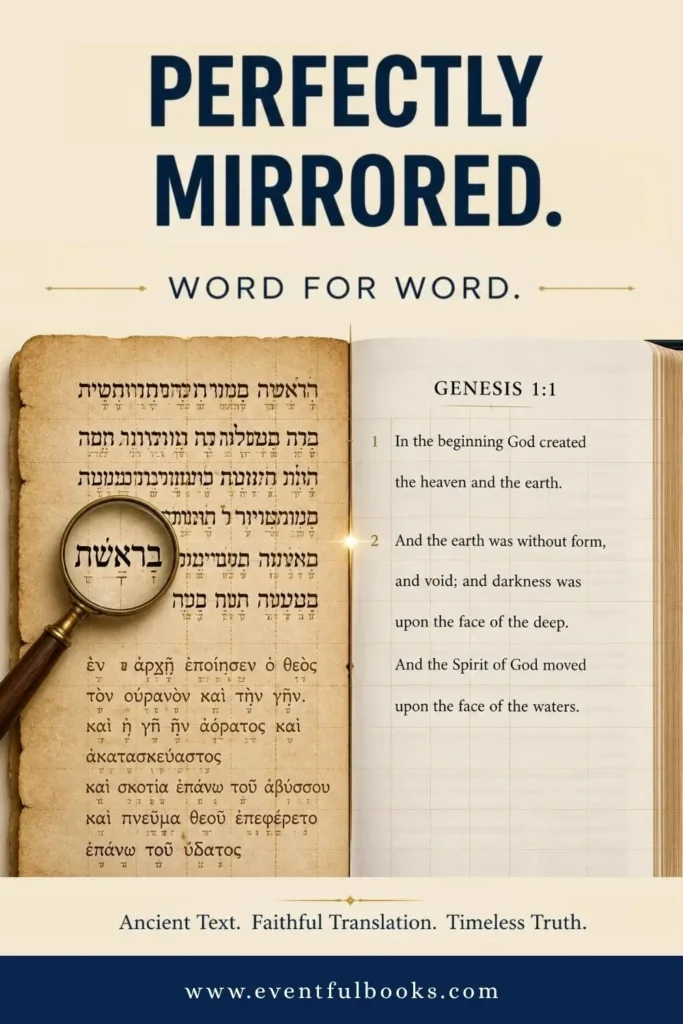
A literal translation aims to stay as close as possible to the exact words and sentence structure of the original Hebrew and Greek — almost like a careful, word-by-word mirror of the ancient text.
The Lexham English Bible is one of the clearest examples of this approach, staying tightly aligned with the original wording even when it makes for slightly less smooth reading in English.
Some translations, like the Christian Standard Bible and the New English Translation, deliberately sit in the middle — they lean literal where possible, but shift toward readability when a strict word-for-word rendering would be confusing.
What Is the King James Bible, and Why Do People Still Use It?
If you picture a Bible with beautiful, old-fashioned “thee” and “thou” language, you’re picturing the King James Version.
First published in 1611, the KJV isn’t just a translation — it’s practically a piece of English literature in its own right, shaping the language of prayer, poetry, and everyday speech for over 400 years.
People still love it today for its rich, reverent tone and its deep historical roots, even though the English it uses can feel a little unfamiliar to modern readers.
What Is the ESV Bible?
The English Standard Version aims to bring together the best of both worlds: the literary beauty of the King James Version with the accuracy of a more literal, word-for-word translation.
It’s become especially popular for serious study and preaching, particularly in Reformed and evangelical circles, thanks to its careful, close-to-the-original wording.
What Is the NRSV Bible?
The New Revised Standard Version is a favorite in academic and mainline church settings, known for its careful, literal approach to the original text.
It’s also available in a Catholic edition, which makes it one of the more widely bridging translations — used comfortably across a range of church traditions.
What Is the NASB Bible?
If precision is what you’re after, the New American Standard Bible is often considered one of the most literal, word-for-word translations available — which is exactly why it’s such a popular choice for a study bible.
It’s less about smooth, casual reading and more about giving you the closest possible window into the original wording, making it a trusted companion for digging deep into a passage.
What Is the WEB Bible?
The World English Bible is a modern, word-for-word translation built on a simple goal: take the accuracy of the 1901 American Standard Version and update its language so it reads naturally for today’s readers.
It was created over more than two decades by a dedicated team of volunteer translators and editors working directly from the original Hebrew and Greek manuscripts.
What Is the Amplified Bible?
The Amplified Bible doesn’t just translate a word — it unpacks it. Using brackets and parentheses, it adds extra shades of meaning right into the verse itself, so instead of picking just one English word for a rich original term, it shows you several.
For example, Genesis 1:1 reads: “In the beginning God (prepared, formed, fashioned, and) created the heavens and the earth.” It’s a favorite for personal study, since it lets you see layers of meaning you might otherwise miss.
What Does “Thought-for-Thought” Bible Translation Mean?
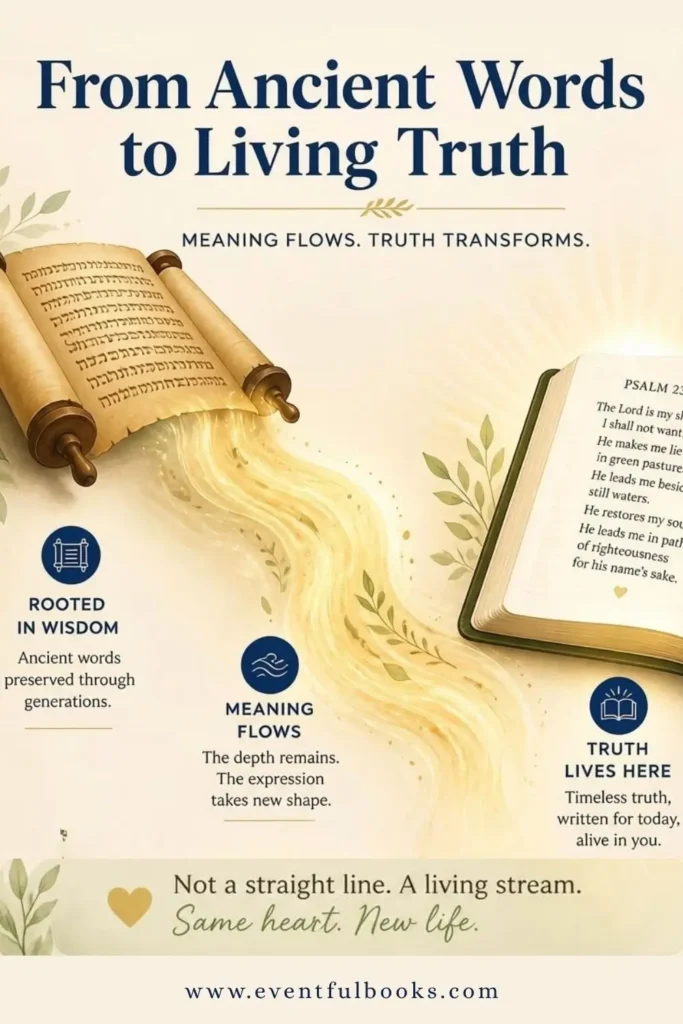
Thought-for-thought translation focuses on capturing the full meaning of a phrase or sentence, then expressing it in natural, easy-to-read English.
The New Living Translation is probably the most popular example, along with the God’s Word Translation (GW), the Common English Bible, the Contemporary English Version, the New English Bible, and the Good News Bible.
These translations tend to read smoothly and feel approachable, especially if you’re newer to reading Scripture regularly.
What Is the NIV Bible?
The New International Version is the best-selling modern English Bible — it strikes a careful balance between staying faithful to the original Hebrew and Greek and reading in clear, natural English.
It’s a favorite across a huge range of churches and denominations, which makes it one of the most common “first Bibles” people are handed.
What Is the NLT Bible?
The New Living Translation NLT takes the meaning of the original text and puts it into some of the simplest, most natural modern English you’ll find.
If you’ve ever felt like a Bible was speaking at you instead of to you, the New Living Translation is often the one that changes that — it’s a favorite for devotional reading, beginners, and anyone who just wants Scripture to feel like it was written for today.
What Is a Paraphrase Bible Translation? (And Is It Actually a “Real” Bible?)
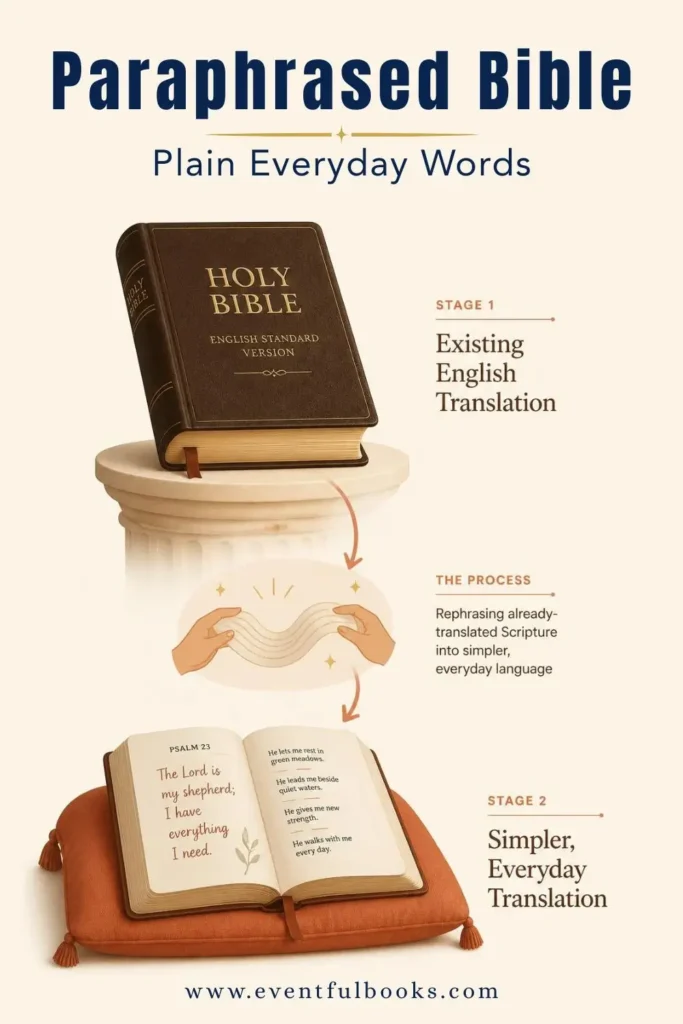
A paraphrase Bible takes things a step further than even a thought-for-thought translation — instead of working directly from the original Hebrew and Greek, it rephrases an already-existing English Bible into more casual, everyday language.
The Living Bible is the most well-known example of this approach. It’s not a direct translation from the original languages, but it’s still Scripture, just presented in a much looser, more personal style.
Many people enjoy reading a paraphrase like this alongside a more literal or different translation, for a fuller, easier-to-digest picture.
What is The Living Bible?
The Living Bible
What Is The Message Bible?
The Message is a true paraphrase — Eugene Peterson rewrote the Bible in bold, conversational, everyday language, aiming to make it feel less like ancient scripture and more like someone talking directly to you. It’s not meant to replace a more literal translation for serious study, but it’s incredibly popular for devotional reading, since it often makes familiar passages feel fresh and alive again.
How Do I Choose the Best Bible Translation for Me?
After everything we’ve covered, you might be feeling one of two ways: either much more confident about what you’re looking for, or a little more overwhelmed by just how many options there actually are. Totally fair either way — so let’s make this simple.
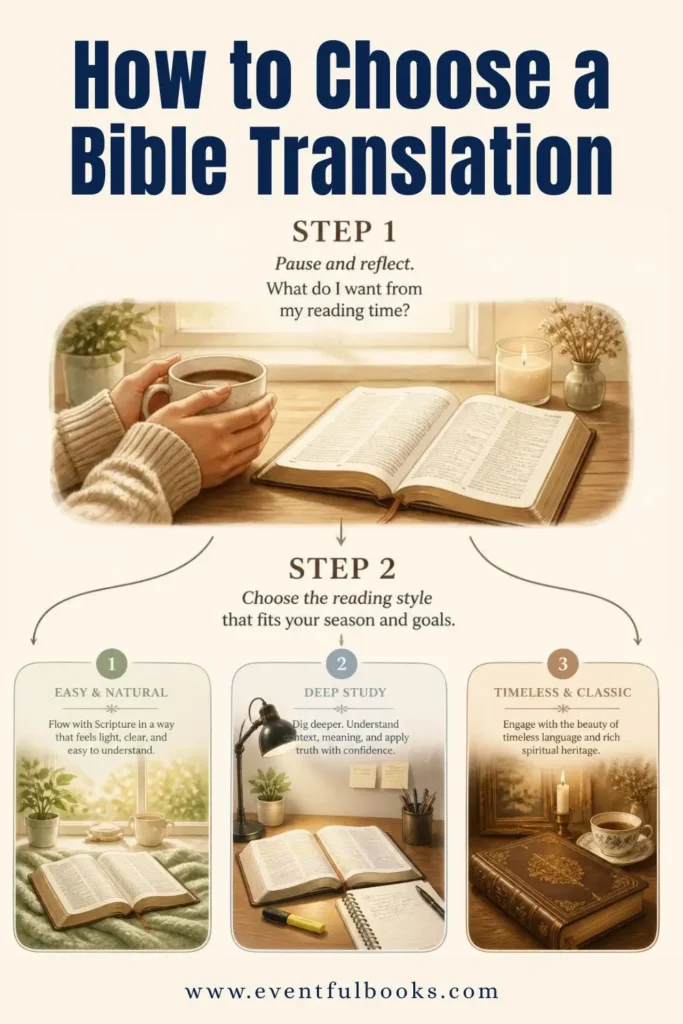
Step 1: Ask what you actually want out of your reading time.
Are you looking for something warm and easy to sit with each morning? Or are you craving deeper study, the kind where every word matters?
Step 2: Match that goal to a translation style.
- If you want Scripture to feel natural and approachable, a thought-for-thought translation like the NIV or NLT is a great place to start.
- If you’re studying deeply, teaching, or love digging into layers of meaning, a literal, word-for-word translation like the ESV or NASB will likely feel more rewarding.
- If you simply love beautiful, timeless language, there’s nothing wrong with the King James Version sitting right alongside your morning coffee.
Step 3: “Try on” a translation before committing.
You don’t have to guess. A free site like Bible Gateway lets you pull up the exact same verse in dozens of versions side by side — so you can compare a different bible translation and see which one actually feels right before you buy anything.
| Translation | Type | Reading Level | Best For | First Published |
|---|---|---|---|---|
| King James VersionKJV | Word-for-Word | Advanced | Literary beauty, tradition | 1611 |
| New International VersionNIV | Thought-for-Thought | Easy | Everyday reading, church use | 1978 |
| English Standard VersionESV | Word-for-Word | Moderate | Study, preaching | 2001 |
| New Living TranslationNLT | Thought-for-Thought | Easy | Beginners, devotional reading | 1996 |
| New Revised Standard VersionNRSV | Word-for-Word | Moderate | Academic study, mainline churches | 1989 |
| New American Standard BibleNASB | Word-for-Word | Advanced | Deep study, word studies | 1971 |
Step 4: Get a little extra guidance along the way.
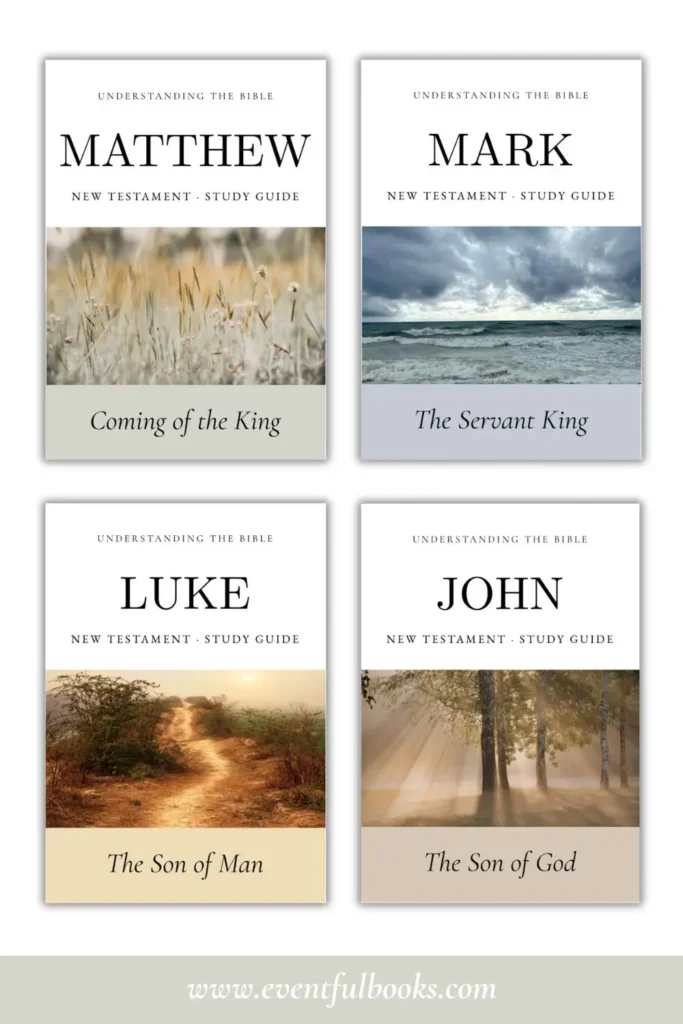
If you want support while you read, our own book-by-book Bible study guides are built to make this whole journey easier.
Each one walks through Scripture using the World English Bible, paired with a simple, plain-English retelling of the story so you’re never left confused about what’s happening.
From there, an Insight section unpacks the deeper meaning behind the passage — the kind of context a modern reader might easily miss.
And to help it stick, each guide closes with two reflection questions to help you connect the passage to your own life.
At the end of the day, there’s no wrong answer here. The best Bible translation is simply the one you’ll actually open, read, and come back to again and again.
What Is the Most Accurate Bible Translation?
This is probably one of the most-asked Bible questions out there, and here’s the honest answer: there isn’t one single “most accurate” translation that every scholar agrees on.
Here’s why. Bible translators aren’t just plugging Hebrew and Greek words into a dictionary — they’re working with ancient manuscripts, and the original Greek text itself sometimes contains words that don’t have one clean English equivalent.
A single Greek word can carry three or four shades of meaning depending on context, so translators have to make careful, thoughtful choices every step of the way.
That means “accuracy” isn’t just about picking the most literal word — it’s about faithfully carrying the full meaning across into English.
That said, if you’re looking for translations widely respected for staying extremely close to the original wording, the New American Standard Bible and English Standard Version are two that scholars frequently point to.
On the other hand, many modern translations — like the NIV or NLT — are just as faithful to the meaning of the text, even though they prioritize smooth, natural English over a strict word-for-word match.
So instead of hunting for one “correct” translation, it’s actually more helpful (and honestly, more worthwhile) to read a couple of different translations side by side.
Comparing them often reveals a fuller, richer picture of what a passage is really saying than any single translation could give you on its own.
What Are the Most Popular Bible Translations?
The most widely read Bible translations today are the King James Version (KJV), New International Version (NIV), English Standard Version (ESV), New Living Translation (NLT), and New American Standard Bible (NASB).
Which Bible Do Catholics Use?
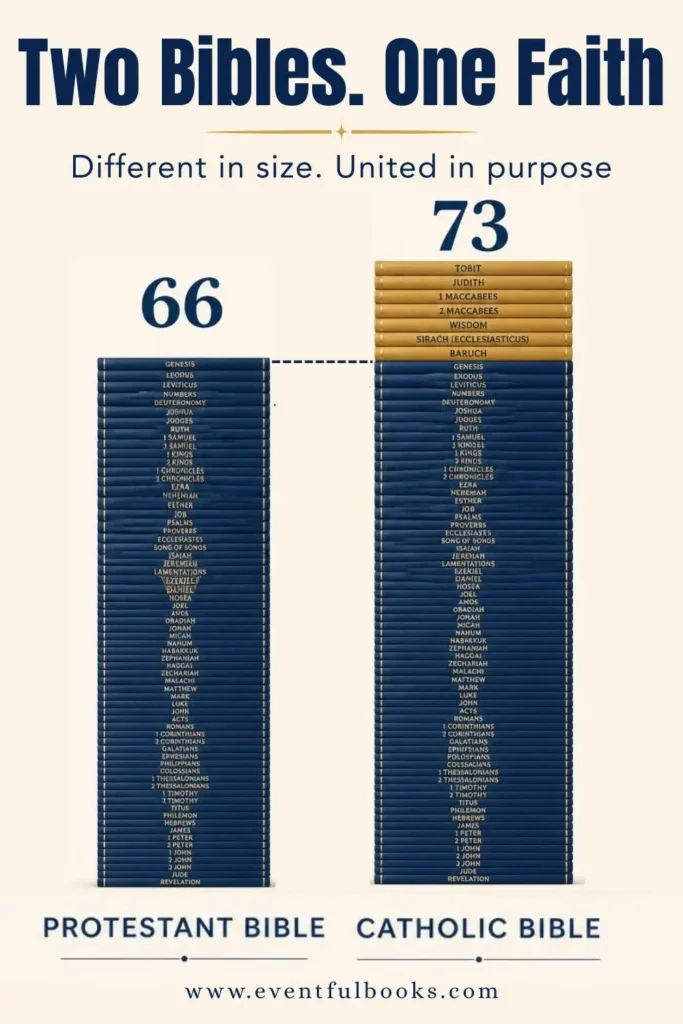
If you’ve ever compared a Catholic Bible to a Protestant one side by side, you might notice something surprising: they’re not identical.
A Catholic Bible contains 73 books in total, while a Protestant Bible contains 66 — the Catholic Bible includes seven additional Old Testament books (like Tobit, Judith, and Wisdom of Solomon), along with some additional material in Esther and Daniel. These extra books are known as the deuterocanonical books, and they’ve been part of the Catholic canon for centuries.
When it comes to translations, Catholic Bibles carry a stamp of Roman Catholic Church approval called an imprimatur, which confirms a translation is free of doctrinal error.
Some translations are approved specifically for private prayer and study, while a smaller set are officially approved for reading aloud during Mass. The New American Bible, Revised Edition (NABRE) is the most widely used Catholic Bible in the United States today.
Final Thoughts
At the end of the day, a Bible translation is so much more than just a version on a shelf — it’s the result of countless people, across centuries and continents, working carefully to make sure the story of Jesus Christ could reach you in a language you can actually understand and hold onto.
There’s no single “perfect” translation, and that’s honestly a beautiful thing. It means there’s likely a Bible out there that fits exactly where you are right now — whether that’s your very first season of faith, or years into a deep, ongoing bible study practice.
The most important step isn’t finding the “right” translation before you begin. It’s simply opening it up and starting.
So take what you’ve learned here, pick the version that feels right for you, and start turning pages. The words have been waiting for you long before you ever picked up the book.
FAQ
Yes — not only can you, many pastors and Bible scholars actually recommend it.
Reading multiple translations side by side can give you a fuller, richer understanding of a passage than any single version could on its own, since each translation makes slightly different choices about how to carry the original meaning into English.
A study bible that includes cross-references or footnotes comparing wording across versions can make this even easier. Many people keep a more literal translation for careful study alongside a more natural, readable one for everyday devotional reading — there’s no rule saying you have to pick just one and stick with it forever.
For most beginners, a thought-for-thought translation like the NIV or NLT is the easiest place to start.
These translations prioritize clear, natural, everyday English, so you’re not stuck untangling unfamiliar sentence structure or older language before you can even understand what’s happening in the passage. If you’re just starting out, we’ve also put together a full guide on how to read the Bible as a new believer that pairs well with whichever translation you choose.
Most beginners find it easier to skip the strict Genesis-to-Revelation order and start somewhere more approachable, like the Gospel of John, before working through the rest of the New Testament and gradually into the Old Testament.
Jumping in at Genesis and reading straight through can be a lot to take on right away, especially once you hit the more genealogy-heavy or law-focused sections. Starting with the story of Jesus first tends to give beginners a much stronger foundation for understanding everything else that follows.
If having a clear path would help, we’ve put together a free, guided Bible reading plan you can grab here to take the guesswork out of where to start and what to read next.
The biggest difference is length — Catholic Bibles contain 73 books, while the Christian bible Bible contains 66, since Catholic Bibles include seven additional Old Testament books known as the deuterocanonical books.
This difference goes back to historical decisions made by each tradition about which ancient texts belonged in the biblical canon, and it’s just one of several distinctions that developed between Catholic and Protestant Christianity over the centuries.